

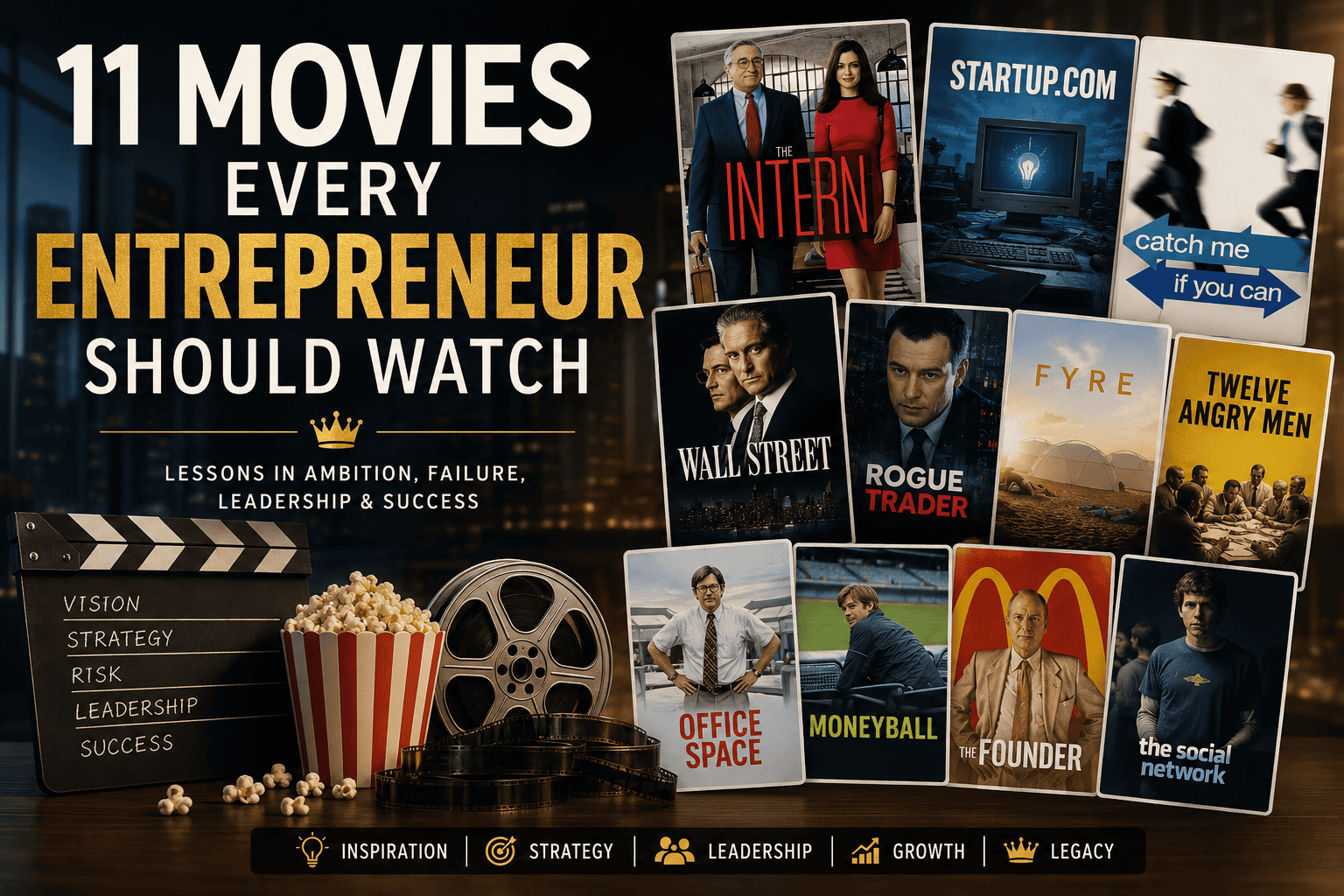
Success leaves clues.
For generations, entrepreneurs have searched for them in books, biographies, interviews, and business case studies. Yet some of the most powerful lessons about business, leadership, risk-taking, and human nature can be found somewhere unexpected:
The movies.
Cinema has a unique ability to transform abstract business concepts into stories we can feel. A balance sheet may explain a company’s finances, but a film can reveal the emotions behind a founder’s decisions. A business textbook can teach strategy, but a great movie can show the consequences of ambition, greed, innovation, loyalty, and resilience.
The best entrepreneurial films are not necessarily about starting companies.
Some explore negotiation.
Others explore leadership.
Some focus on ethics.
Others examine risk.
Together, they offer a masterclass in understanding people—the most important skill in business.
The films featured in entrepreneurial recommendation lists repeatedly include titles such as The Intern, Moneyball, The Social Network, The Founder, Catch Me If You Can, and Wall Street. While these movies differ dramatically in tone and subject matter, each contains valuable insights for builders, creators, and leaders.
Here are eleven films every entrepreneur should watch and the lessons they teach.
1. The Intern (2015)
Perhaps the most surprising film on this list is The Intern.
At first glance, it doesn’t appear to be a business movie at all.
The story follows Ben Whittaker, a seventy-year-old widower who becomes a senior intern at a fast-growing e-commerce startup founded by Jules Ostin.
Unlike films that glorify disruption and hustle culture, The Intern focuses on something often overlooked in modern entrepreneurship:
Experience.
In an era obsessed with speed, youth, and innovation, Ben represents timeless professional values.
Reliability.
Patience.
Courtesy.
Emotional intelligence.
The film quietly demonstrates that success is not solely about technology or growth metrics. Building a company also requires trust, relationships, leadership, and maturity.
One of the most valuable lessons entrepreneurs can learn from The Intern is that wisdom compounds just as capital does.
While industries evolve, human nature remains remarkably consistent.
A founder who understands people possesses a competitive advantage that never goes out of style.
As the film’s tagline beautifully states:
“Experience never goes out of fashion.”
2. Startup.com (2001)
Few documentaries capture entrepreneurial reality as accurately as Startup.com.
The film follows the rise and collapse of GovWorks, a technology startup created during the dot-com boom.
Unlike fictional business dramas, this documentary shows entrepreneurship exactly as it is:
Messy.
Stressful.
Uncertain.
Personal.
The founders begin with ambition and optimism. As the company grows, however, tensions emerge.
Friendships are tested.
Investors demand results.
Pressure intensifies.
Decisions become increasingly difficult.
The film serves as a reminder that startups are not merely products or companies.
They are collections of human relationships.
Many businesses fail not because of bad ideas but because of conflicts, poor communication, and leadership challenges.
Watching Startup.com is like attending an MBA course taught by reality itself.
3. Catch Me If You Can (2002)
At first glance, a film about a con artist might seem like an unusual entrepreneurial recommendation.
Yet Catch Me If You Can offers fascinating insights into persuasion, branding, confidence, and opportunity recognition.
The story follows Frank Abagnale Jr., who successfully impersonates a pilot, doctor, and lawyer while evading authorities.
While his actions are illegal, the film highlights several skills that entrepreneurs frequently rely upon:
Adaptability.
Communication.
Resourcefulness.
Confidence under pressure.
Frank succeeds because he understands perception.
He recognizes how people make assumptions and how trust is established.
For entrepreneurs, the lesson is not to deceive.
The lesson is to understand how credibility works.
People buy from people they trust.
People invest in founders they believe in.
People follow leaders who inspire confidence.
Perception matters.
Integrity matters even more.
4. Wall Street (1987)
Few films explore the seductive nature of success better than Wall Street.
The story follows Bud Fox, an ambitious young stockbroker who becomes involved with Gordon Gekko, a wealthy corporate raider famous for declaring:
“Greed, for lack of a better word, is good.”
The film became iconic because it captures a timeless tension within business:
The conflict between ambition and ethics.
Entrepreneurs naturally desire growth.
They want success.
They want wealth.
There is nothing wrong with that.
The danger emerges when achievement becomes disconnected from values.
Wall Street asks an uncomfortable question:
How much are you willing to sacrifice to win?
The entrepreneurs who build lasting legacies understand that reputation is one of the most valuable assets they possess.
Once lost, it is difficult to recover.
5. Rogue Trader (1999)
The collapse of financial institutions often begins with a small decision.
Then another.
Then another.
Rogue Trader tells the true story of Nick Leeson, whose unauthorized trading activities led to the collapse of Barings Bank.
For entrepreneurs, the film illustrates the importance of risk management.
Many founders focus intensely on growth.
Fewer focus on downside protection.
The reality is that a business survives not merely because it succeeds but because it avoids catastrophic mistakes.
One reckless decision can erase years of progress.
Successful entrepreneurs understand leverage.
Great entrepreneurs understand limits.
The difference can determine survival.
6. Fyre (2019)
If Startup.com demonstrates the challenges of entrepreneurship, Fyre demonstrates the dangers of illusion.
The documentary examines the infamous Fyre Festival, a luxury music festival that promised paradise but delivered chaos.
On paper, the concept was brilliant.
The marketing was extraordinary.
The social media campaign generated massive excitement.
The demand was real.
The execution was disastrous.
For modern entrepreneurs, Fyre provides a critical lesson:
Marketing cannot permanently compensate for operational failure.
A beautiful brand attracts customers.
A reliable product keeps them.
The companies that endure are those capable of delivering on their promises.
Trust, once broken, is difficult to restore.
7. Twelve Angry Men (1957)
Many people are surprised to see Twelve Angry Men on entrepreneurial movie lists.
After all, it is neither a startup story nor a business drama.
Yet it may contain one of the most important lessons any entrepreneur can learn:
How to think.
The film follows twelve jurors deliberating a murder case.
Initially, eleven jurors believe the defendant is guilty.
Only one dissents.
What follows is a masterclass in critical thinking, persuasion, communication, and decision-making.
Entrepreneurs constantly face uncertainty.
Markets change.
Data is incomplete.
Opinions conflict.
The ability to challenge assumptions often separates exceptional leaders from average ones.
The film teaches a valuable principle:
Consensus is not always correctness.
Sometimes progress begins with a single person asking a better question.
8. Office Space (1999)
Entrepreneurs frequently dream of escaping corporate bureaucracy.
Office Space perfectly captures why.
The film humorously examines workplace frustration, disengagement, and meaningless corporate routines.
Although presented as a comedy, it contains profound insights into motivation.
Many organizations focus on processes while neglecting people.
They measure activity rather than outcomes.
They create complexity where simplicity would suffice.
For entrepreneurs, the lesson is clear.
A great company culture is not created through slogans.
It emerges from respect, autonomy, clarity, and purpose.
Employees perform best when they understand why their work matters.
9. Moneyball (2011)
Few films demonstrate innovation better than Moneyball.
Based on a true story, the film follows Billy Beane, general manager of the Oakland Athletics, as he challenges traditional baseball scouting methods.
Unable to compete financially with wealthier teams, Beane turns to data.
Instead of relying on conventional wisdom, he identifies undervalued opportunities.
The results transform the sport.
Entrepreneurs can learn several lessons from Moneyball:
Question assumptions.
Use data intelligently.
Look where others are not looking.
Competitive advantages often emerge from unconventional thinking.
The companies that dominate tomorrow frequently succeed because they see value others overlook today.
10. The Founder (2016)
Every entrepreneur should watch The Founder.
The film tells the story of Ray Kroc and the transformation of McDonald’s from a small restaurant into a global empire.
What makes the film fascinating is that it is not simply a success story.
It is a story about vision, persistence, strategy, and controversy.
Kroc recognized something extraordinary in the McDonald brothers’ system.
More importantly, he understood scalability.
Many entrepreneurs build excellent products.
Far fewer build systems capable of expanding.
One of the film’s most important lessons is that business success often depends less on invention and more on execution.
Ideas matter.
Execution matters more.
11. The Social Network (2010)
No modern entrepreneurial film has influenced startup culture more than The Social Network.
The story chronicles the creation of Facebook and the conflicts that accompanied its rise.
Beyond the legal disputes and personal drama lies a powerful lesson about innovation.
Great companies frequently emerge from solving simple problems exceptionally well.
Facebook began as a relatively small project.
Its growth transformed global communication.
The film also highlights the realities of entrepreneurship:
Competition.
Partnership conflicts.
Scaling challenges.
Rapid growth.
Public scrutiny.
Success often appears glamorous from the outside.
The journey itself is rarely simple.
What These Films Have in Common
Although these movies span different industries and decades, they share several recurring themes.
Success Requires More Than Intelligence
The smartest person in the room does not always win.
Emotional intelligence, communication skills, resilience, and leadership often matter just as much.
Relationships Matter
Whether in Startup.com, The Social Network, or The Intern, human relationships repeatedly determine outcomes.
Business is ultimately about people.
Ethics Matter
Wall Street, Rogue Trader, and Fyre all demonstrate how short-term decisions can create long-term consequences.
Reputation remains one of the most valuable assets any entrepreneur possesses.
Innovation Comes From Different Thinking
Moneyball and The Founder show that breakthrough results often emerge when someone challenges conventional assumptions.
Execution Beats Ideas
Many people have ideas.
Few execute consistently.
The films repeatedly emphasize that implementation creates value.
Why Entrepreneurs Should Watch More Movies
Business education often focuses on numbers.
Revenue.
Margins.
Growth rates.
Valuations.
These metrics are important.
Yet entrepreneurship is fundamentally a human endeavor.
It involves ambition, fear, trust, persuasion, leadership, failure, creativity, and resilience.
Movies bring these realities to life in ways spreadsheets cannot.
A great film allows entrepreneurs to experience situations from multiple perspectives.
It reveals consequences.
It creates empathy.
It encourages reflection.
Sometimes a two-hour movie can teach a lesson that years of experience might otherwise be required to learn.
The Scarlet Kingdom Perspective
Luxury is often associated with material success.
But true sophistication comes from understanding people.
The greatest entrepreneurs are not merely builders of products.
They are students of human behavior.
That is why films remain such valuable teachers.
The best entrepreneurial movies are not instruction manuals.
They are mirrors.
They reveal our ambitions, strengths, weaknesses, fears, and aspirations.
Whether it is the wisdom of The Intern, the innovation of Moneyball, the ambition of The Founder, or the cautionary lessons of Fyre, each story offers insight into what it means to create something meaningful.
Success leaves clues.
Sometimes those clues are hidden in boardrooms.
Sometimes they are hidden in biographies.
And sometimes, they are waiting on a movie screen.
The entrepreneurs who never stop learning will find lessons everywhere—even in the closing credits.