
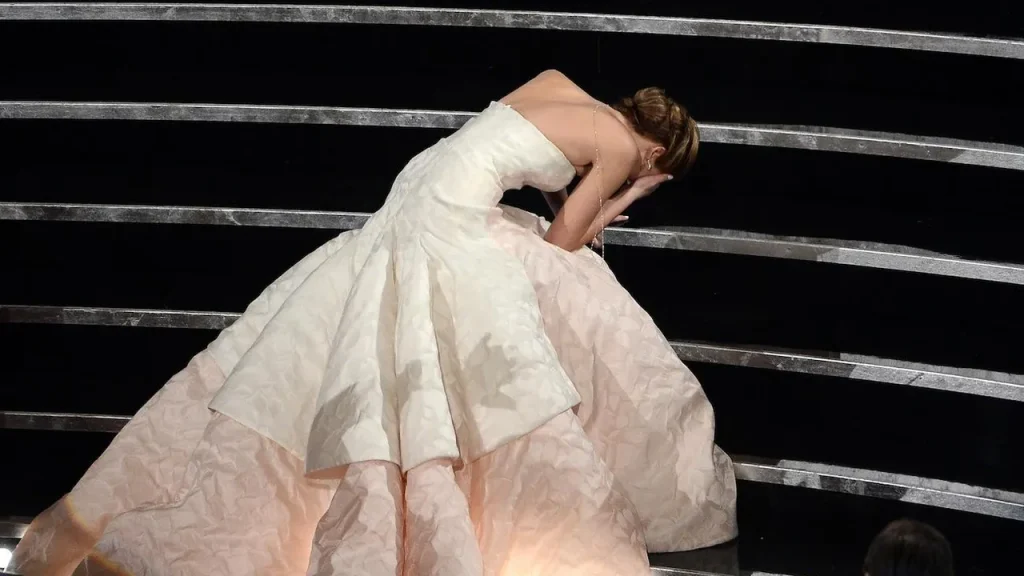
For one extraordinary second, the kingdom of Hollywood seemed to hold its breath.
The lights of the Dolby Theatre were blazing.
Hundreds of the world’s most famous faces were watching.
Millions more were watching from beyond the theatre, gathered around televisions, laptops and glowing screens, waiting to see who would take home one of the most coveted prizes in cinema.
And then her name was announced.
Jennifer Lawrence.
Best Actress.
For Silver Linings Playbook.
At only twenty-two years of age, Lawrence had just achieved the sort of victory actresses dream about for an entire lifetime.
She rose.
She smiled.
She began walking towards the stage.
And then—
She fell.
Not discreetly.
Not gracefully enough to be ignored.
She stumbled on the grand staircase in front of the entire world.
Her magnificent gown caught beneath her as she climbed, and suddenly the evening that was supposed to belong entirely to Oscar glory became something else.
Something far more human.
Something nobody had written into the evening’s script.
Even Hugh Jackman, seated nearby, was seen moving to help her as she recovered.
And yet, somehow, that fall did not diminish Jennifer Lawrence.
It crowned her.
Because what happened next was far more memorable than the fall itself.
She kept walking.
She reached the microphone.
She looked at the standing ovation.
And with the kind of self-awareness that cannot be purchased, rehearsed or tailored into existence, she laughed.
“You guys are just standing up because you feel bad that I fell.”
The room laughed with her.
And just like that, embarrassment became charm.
A disaster became a story.
And a woman who had quite literally fallen on her way to the highest honour of her profession managed to stand before the world with more confidence than if she had never stumbled at all.
The Most Beautiful Mishap in Hollywood
The 85th Academy Awards took place on February 24, 2013.
Lawrence won Best Actress for portraying Tiffany Maxwell in Silver Linings Playbook, defeating a formidable field that included Jessica Chastain, Emmanuelle Riva, Quvenzhané Wallis and Naomi Watts.
On paper, that should have been the defining image of the evening.
The Oscar.
The victory.
The acceptance speech.
The young actress ascending into the upper chamber of Hollywood royalty.
Instead, history gave us something much more entertaining.
A staircase.
A spectacular gown.
A young woman.
And one very unfortunate step.
Yet perhaps that is precisely why the moment survived.
Hollywood is built upon perfection.
Perfect lighting.
Perfect gowns.
Perfect photographs.
Perfect smiles.
Perfect bodies.
Perfect speeches.
Perfect entrances.
Every detail is calculated.
Every appearance is examined.
Every photograph can be frozen forever.
And then Jennifer Lawrence fell.
For a moment, all that perfection disappeared.
What remained was a human being.
And audiences loved her for it.
The Gown Was Almost a Character of Its Own
One cannot properly tell this story without speaking of the dress.
Because Jennifer Lawrence did not fall wearing an ordinary evening gown.
She fell wearing Dior Haute Couture.
The pale pink, strapless creation was designed by Raf Simons for Christian Dior and featured an enormous sculptural skirt and a dramatic train.
It was elegant.
It was extravagant.
It was unmistakably couture.
And, as the evening demonstrated, it was also rather capable of causing trouble.
The silhouette was expansive, with layers of fabric extending around Lawrence like a pale cloud.
The sort of dress that does not merely accompany a woman into a room.
It enters first.
It announces her.
It demands architecture around itself.
And yet, while the gown looked magnificent beneath the Oscar lights, it was precisely that abundance of fabric that contributed to Lawrence’s unfortunate encounter with the staircase.
She later explained that she had stepped on the fabric while climbing the stairs and joked about the difficulty of navigating the dress.
Thus the dress became more than fashion.
It became part of the story.
A Princess Falls, But Does Not Break
There is something almost medieval about the image.
A young woman in a magnificent pale gown.
A golden trophy waiting above.
An audience of nobles.
Flashbulbs illuminating the chamber.
And then the princess trips upon the staircase.
Except this was not a fairy tale.
There was no carefully choreographed rescue.
There was no cinematic music.
There was simply Jennifer Lawrence, facedown upon the stairs, with the entire world watching.
And perhaps that is what made the moment so oddly beautiful.
She did not behave as though she had been ruined.
She behaved as though she had fallen.
There is a profound distinction.
We are often taught that elegance means never making a mistake.
But perhaps genuine elegance is something else.
Perhaps elegance is the ability to make a mistake without allowing the mistake to dictate who you are.
Lawrence did not attempt to pretend it had not happened.
She did not arrive at the microphone with a frozen expression and an artificial smile.
She acknowledged it.
She laughed.
She continued.
That is confidence.
Not perfection.
Confidence.
The Standing Ovation
When Lawrence finally reached the podium, the audience gave her a standing ovation.
It was a remarkable sight.
She had just fallen.
And yet everyone was standing.
She immediately understood the absurdity of it.
Her first instinct was humour.
“You guys are just standing up because you feel bad that I fell.”
It was a perfect line because it was so completely human.
She did not turn the moment into a dramatic declaration.
She did not pretend to be above embarrassment.
She admitted that it was embarrassing.
And because she admitted it, everyone was free to laugh with her rather than at her.
That distinction matters.
The audience was not laughing because she had fallen.
They were laughing because she had survived the fall with an extraordinary sense of humour.
She had taken control of the story.
And that is perhaps one of the most powerful forms of glamour.
When Vulnerability Becomes Beautiful
Fashion is often described in terms of beauty.
Silhouette.
Fabric.
Colour.
Craftsmanship.
Proportion.
But fashion can also reveal personality.
A dress may make someone look elegant.
A certain pair of shoes may make someone appear powerful.
A particular suit may communicate authority.
But no garment can create character.
That must come from the person wearing it.
Jennifer Lawrence proved that on the greatest fashion stage imaginable.
The Dior gown was magnificent before she fell.
Afterwards, it became unforgettable.
Not because the dress was damaged.
Not because the design suddenly changed.
But because the gown became associated with a moment of extraordinary vulnerability.
She was not an untouchable fashion photograph anymore.
She was a young woman having a very human evening.
And somehow, that made the couture even more memorable.
“If You Fall, Fall in Dior”
The phrase “If you fall, fall in Dior” became one of the most enduring expressions associated with the incident.
Fashion publications and audiences embraced the idea almost immediately, transforming an awkward moment into a playful celebration of couture.
It is an amusing philosophy.
If disaster is inevitable, one might as well arrive beautifully dressed.
There is almost a royal absurdity to it.
If one must stumble before millions, perhaps there is something reassuring about knowing that at least the fabric is exquisite.
And therein lies the charm.
The phrase was never really about falling.
It was about how one rises.
That is the part people remember.
The fall lasted seconds.
The response lasted years.
Dior and the Art of Turning Accidents Into Icons
Fashion houses spend enormous sums attempting to create memorable moments.
Campaigns are photographed.
Collections are staged.
Celebrities are dressed.
Runways are constructed.
Stories are carefully developed.
Yet sometimes the most powerful fashion image is not planned at all.
Jennifer Lawrence’s Oscars moment became one of those accidents that fashion history simply refused to forget.
The gown was already a significant piece of couture.
Raf Simons was then at the helm of Dior, and the house’s association with Lawrence was already significant; she had been the face of Miss Dior and had spoken publicly about the confidence she felt wearing Dior.
But nobody could have designed the publicity that came from that staircase.
Nobody could have scheduled the fall.
Nobody could have choreographed Hugh Jackman’s reaction.
Nobody could have scripted the laughter.
And nobody could have manufactured Lawrence’s response.
That is why the image feels authentic.
The Luxury of Imperfection
There is a strange lesson here for anyone fascinated by luxury.
Luxury is often associated with perfection.
The immaculate hotel.
The flawless diamond.
The perfectly cut suit.
The couture gown.
The polished table.
The champagne glass positioned precisely where it belongs.
But perhaps true luxury has another side.
The freedom to be imperfect.
The freedom to laugh.
The freedom to stumble without believing that the world has ended.
Jennifer Lawrence’s Oscar fall demonstrated something that photographs of perfect red carpets cannot.
You can wear haute couture and still be human.
You can hold an Oscar and still trip.
You can stand beneath millions of cameras and still laugh at yourself.
And none of these things make you less elegant.
If anything, they make the elegance believable.
The Girl Who Refused to Become a Statue
Awards ceremonies can turn people into statues.
The winners stand beneath lights.
They hold trophies.
They smile for photographs.
Their names become attached to titles.
Best Actress.
Best Actor.
Best Director.
Winner.
Nominee.
Icon.
Legend.
But before all of those labels, there is a person.
Jennifer Lawrence never seemed particularly interested in pretending she was a marble statue.
Her public personality had long carried a reputation for humour and self-deprecation.
And on that Oscar night, the contrast between Hollywood grandeur and ordinary human awkwardness became almost perfect.
She was wearing couture.
She had just won an Academy Award.
She was surrounded by the world’s most famous actors.
And yet she was also the young woman who had just fallen over.
The two identities existed simultaneously.
And neither cancelled the other.
The Photograph That Outlived the Speech
Ask people about Jennifer Lawrence’s 2013 Oscar victory and many will remember the dress before they remember the speech.
That is the curious power of visual memory.
A photograph can become a sentence.
The pale pink gown.
The enormous skirt.
The staircase.
The Oscar.
Her expression.
The moment she recovered.
The image tells the entire story without requiring explanation.
It captures triumph and embarrassment in the same frame.
Success and vulnerability.
Luxury and chaos.
Hollywood fantasy and ordinary humanity.
Perhaps that is why the moment became so beloved.
It contained contradictions.
And contradictions are often what make fashion memorable.
The Dress That Almost Defeated Its Queen
There is a delicious irony in the fact that Lawrence’s greatest fashion moment involved her nearly being defeated by her own gown.
The dress was created to make her magnificent.
And it did.
It was designed to command the room.
And it did.
It was intended to create a dramatic silhouette.
And it certainly did.
But when Lawrence began climbing those stairs, the sheer amount of fabric became an obstacle.
She later explained that her dress had effectively become part of the problem.
It is almost Shakespearean.
The queen is betrayed by her own royal robes.
Yet she rises.
And takes the crown.
Why We Loved Her More Afterwards
Perhaps the greatest secret of celebrity is that audiences rarely fall in love with perfection.
They admire perfection.
But they connect with humanity.
A flawless celebrity can appear distant.
Someone who makes a mistake and laughs may suddenly feel familiar.
Jennifer Lawrence’s fall shortened the distance between Hollywood and the audience.
For a few seconds, she was not an actress surrounded by stylists, designers, photographers and publicists.
She was simply Jennifer.
She had fallen.
It was embarrassing.
She knew it.
We knew it.
And she laughed.
That was enough.
A Lesson in Grace
There is an old idea that grace means moving through life without difficulty.
I disagree.
Grace is what happens after difficulty arrives.
Grace is standing again.
Grace is looking at the room and smiling.
Grace is admitting that something embarrassing happened without allowing embarrassment to own you.
Grace is refusing to become smaller because everyone saw you stumble.
Jennifer Lawrence demonstrated that kind of grace without giving a lecture about it.
She simply lived it.
And perhaps that is why the moment remains more powerful than any perfectly rehearsed inspirational speech.
The Oscar Was Still Hers
Of course, there is one detail that must never be forgotten.
Jennifer Lawrence had not merely fallen.
She had won.
She was the Best Actress of the evening.
The Academy officially records her victory for Silver Linings Playbook.
The fall did not erase the achievement.
It became part of it.
That is an important distinction.
Sometimes life places an embarrassing little footnote beside a major accomplishment.
It does not mean the accomplishment is diminished.
Sometimes the footnote is what makes people remember the achievement with affection.
Lawrence did not become famous because she fell.
She became memorable because she fell after winning and responded like a human being.
The Royal Rule: Rise Beautifully
There is a lesson here that extends well beyond Hollywood.
You will stumble.
Everyone does.
Perhaps not beneath Oscar lights.
Perhaps not in couture.
Perhaps not while millions are watching.
But eventually, life will place a staircase before you that you did not expect.
You will misjudge a step.
Something will go wrong.
Someone will notice.
And for one horrible second, you will wish the earth would kindly open and swallow you.
But then you must do what Jennifer Lawrence did.
Get up.
Breathe.
Smile.
Keep walking.
Because the fall is not the final chapter.
The response is.
A Moment That Became Immortal
More than a decade later, Jennifer Lawrence’s Oscar fall remains one of the most recognisable mishaps in Academy Awards history.
It has been replayed, photographed, discussed, parodied and remembered.
And strangely enough, the moment has aged beautifully.
Perhaps because it represents something that Hollywood does not often permit:
imperfection without shame.
She did not lose her dignity when she fell.
She revealed it.
She showed that elegance does not require a person to remain untouched by embarrassment.
Sometimes elegance is simply the courage to continue.
And so the image remains.
A pale pink Dior gown.
A staircase.
An Oscar.
A young actress.
A room full of stars.
A standing ovation.
And a laugh.
It is almost too perfect to have been planned.
Which is precisely why it is so perfect.
And So, If You Must Fall…
There are moments in fashion that belong to designers.
There are moments that belong to photographers.
There are moments that belong to models.
And then there are moments that belong entirely to the person wearing the clothes.
Jennifer Lawrence’s 2013 Oscar moment belongs to the latter.
Dior provided the gown.
Hollywood provided the staircase.
The Academy provided the Oscar.
But Jennifer Lawrence provided the thing none of them could manufacture:
the grace to laugh when everything went wrong.
That is why the fall did not become a humiliation.
It became an entrance into legend.
The world saw her stumble.
Then it watched her rise.
And perhaps that is the most luxurious lesson of all.
Not that you should never fall.
Not that you should always be perfect.
Not that elegance means remaining untouched.
But that when life knocks the crown from your head, you should pick it up, straighten your gown, look the kingdom in the eye—and continue walking.
Preferably in Dior.
If you fall, fall in Dior.
But more importantly—
when you rise, rise beautifully.