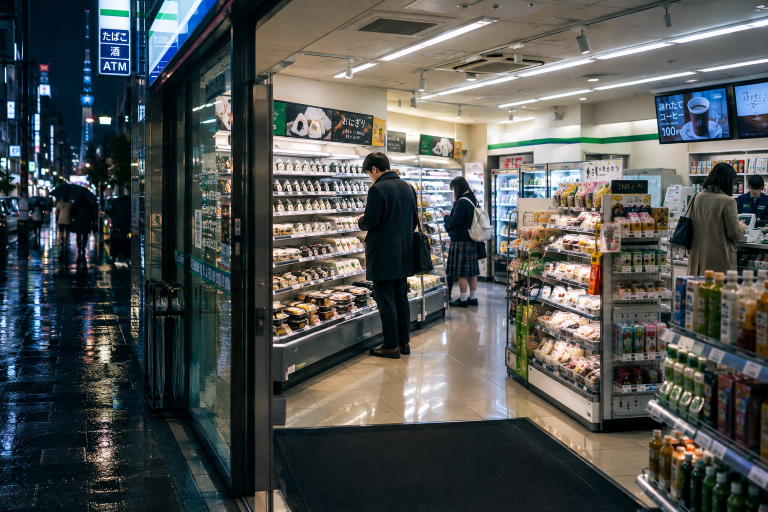
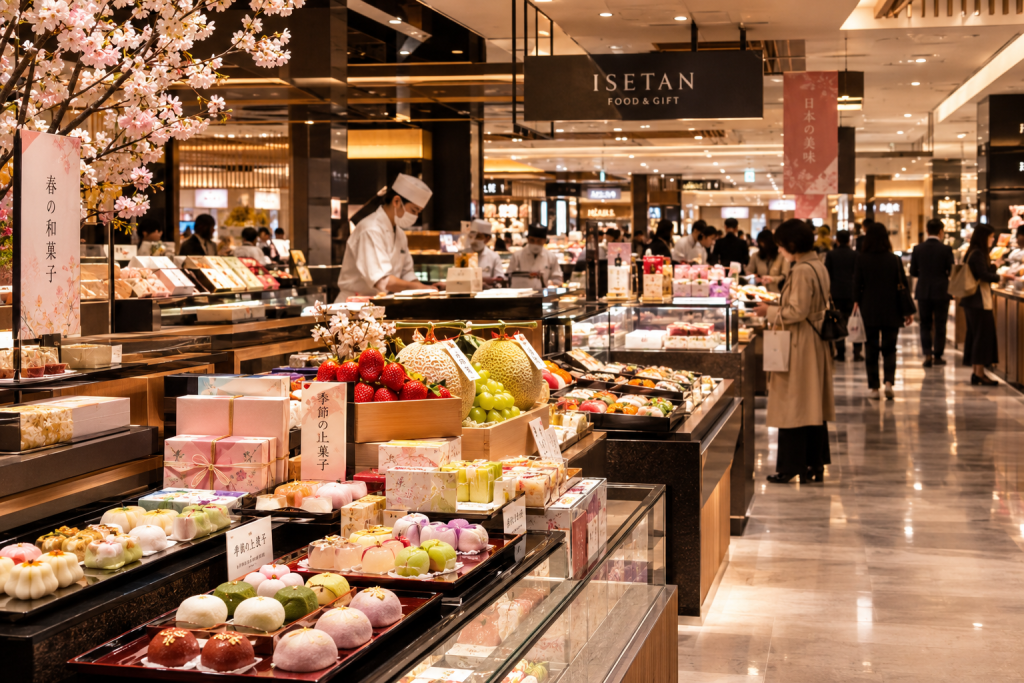
There is a particular moment in Tokyo when luxury changes character.
You may have spent the afternoon among immaculate handbags, watches, jewellery and beautifully cut clothing. Perhaps you have walked through the polished floors of Isetan Shinjuku, where fashion and contemporary Japanese design occupy the upper reaches of the building. Or perhaps you have wandered through the grander, more historic world of Nihombashi Mitsukoshi or Takashimaya.
Then you take the escalator down.
One floor.
And suddenly, the language of luxury is no longer leather, gold or silk.
It is fruit.
A perfect peach sits beside another perfect peach. Cakes appear almost too precisely constructed to disturb with a fork. Wagashi resemble miniature landscapes. Sushi is arranged with the discipline of a jeweller setting stones. Bento boxes are composed with such care that lunch begins to resemble design.
There are chocolates, tea, sake, tempura, grilled seafood, salads, pickles, pastries and regional delicacies. There are counters devoted to established confectioners and specialists you may never have encountered outside Japan. There are seasonal products that will disappear when the calendar moves on.
And then there is the wrapping.
A purchase can be folded, boxed and wrapped with such precision that the packaging itself seems to have become part of the product.
This is the world of the depachika — the Japanese department-store basement food hall, from depāto (department store) and chika (basement). These spaces are neither quite supermarkets nor food courts. They are markets, delicatessens, confectionery galleries, gift destinations and showcases for Japanese food culture, often with international products woven into the same carefully choreographed environment.
And that is precisely why they are worth taking seriously.
A depachika is not simply somewhere to buy dinner.
It is one of the places where Japan’s ideas about food, beauty, hospitality, seasonality, commerce and luxury become visible at the same time.
What Exactly Is a Depachika?
The simplest definition is the least interesting one.
A depachika is the food floor of a Japanese department store, generally found underground and filled with specialist counters selling everything from prepared meals and fresh ingredients to sweets, tea, fruit, alcohol and gifts.
But that description misses the peculiar brilliance of the format.
A good depachika allows several different food experiences to coexist.
One customer may be buying a bento before boarding a train. Another may be selecting an elaborate box of sweets for a business associate. Someone else may be looking for a birthday cake. A visitor may be studying expensive fruit. A resident may be buying dinner after work. A collector of Japanese confectionery may be searching for a seasonal wagashi that will only exist for a few weeks.
The same floor serves all of them.
Japan’s National Tourism Organization describes depachika as food markets offering both prepared foods and fresh ingredients, including bento, sweets, meat, fish, tea and imported products. Their location within major department stores — frequently connected to railway stations — is part of their appeal.
That combination of convenience and refinement is important.
The depachika does not require food to become formal before it becomes beautiful.
A meal intended to be carried home can receive almost the same attention to presentation as something served in a restaurant.
That is one of the first clues to understanding its place in Japanese life.
The Department Store as a Japanese Institution
The story begins long before the word depachika became fashionable.
The institutions behind Tokyo’s great department stores have histories that stretch back well beyond modern luxury retail. Mitsukoshi traces its origins to Echigoya, founded in Edo in 1673. The business developed a cash-and-fixed-price approach in the seventeenth century and later became one of the institutions that helped establish the Japanese department-store model. Its Nihombashi building opened in 1914, complete with what the company describes as Japan’s first escalator in its main entrance.
Isetan’s roots are younger but still substantial. It began in 1886 as Iseya Tanji Gofukuten, a kimono and textiles business, adopted the department-store format in the aftermath of the 1923 Great Kantō Earthquake, and opened its Shinjuku main store in 1933.
These histories matter because Japanese department stores were never simply enlarged versions of ordinary shops.
They developed into places where fashion, craftsmanship, food, culture, events and social rituals could occupy the same institution.
Food naturally became an important part of that world.
There is some nuance surrounding the exact origin of the modern depachika. Nagoya City Library’s research into the subject notes that Takashimaya’s Nagahori store in Osaka had a basement food department as early as 1922, while Matsuzakaya Nagoya established the Tōzai Meibutsugai in its basement in 1936 — an influential concentration of famous food brands from different cities.
The point is not to crown one building the sole inventor.
The more interesting development was the transformation of basement food retail into a destination in its own right.
By the late twentieth century, the format was becoming increasingly sophisticated. In 2000, a major renovation of the Tokyu Department Store’s Shibuya food floor helped bring the modern depachika concept into wider public attention, shifting the basement from an environment associated heavily with high-end gifts toward a broader and more contemporary food experience.
The basement had become a stage.
Why the Basement Became the Kingdom of Food
There is a certain delicious irony to the architecture.
Above you may find the handbags, watches and fashion houses.
Below them, you find the food.
Yet food may actually be the department store’s most intimate expression of luxury.
A handbag can communicate status.
A watch can communicate taste.
But food is consumed. It has a season. It has a shelf life. It must be handled carefully. It can be shared. It can disappear.
That makes its presentation strangely powerful.
The basement is also where urban practicality meets aspiration.
Tokyo is a city of extraordinary density and movement. Department stores are frequently integrated into major commercial districts and railway networks, making them convenient for commuters as well as shoppers. JNTO notes that many depachika are directly connected to stations and can be particularly convenient in a city where people are constantly moving between home, work and transport hubs.
The result is a remarkable contradiction.
The food is luxurious enough to photograph.
But it is also practical enough to carry home.
A depachika does not demand that luxury remain ceremonial.
It allows luxury to become dinner.
The Art of Making Food Look Worthy
The first thing a foreign visitor often notices is not taste.
It is precision.
Japanese food retail has developed an unusually sophisticated relationship with visual presentation. The arrangement of fruit, the spacing of confectionery, the colour of packaging and the architecture of a display case all communicate value before anything is eaten.
Wagashi makes this particularly obvious.
Traditional Japanese confectionery is not merely designed to taste good. It is closely associated with aesthetic beauty and the changing seasons. JNTO describes wagashi as confectionery shaped by principles of beauty and seasonality, with forms inspired by flowers, leaves, fruits and other natural imagery.
A small confection can therefore perform several functions simultaneously.
It is food.
It is craft.
It is seasonal symbolism.
And sometimes, it is a gift.
That explains why a box of Japanese sweets can feel almost unnervingly precious.
The packaging does not merely protect the contents. It frames them.
The box creates anticipation.
The arrangement creates hierarchy.
The wrapping creates ceremony.
And the object inside completes the composition.
This is luxury through restraint rather than excess.
When the Basement Changes With the Seasons
One of the great pleasures of depachika is that it is never completely the same place twice.
Japanese food culture places considerable importance on seasonality. JNTO notes that seasonality influences not only ingredients and flavours but also the appearance and plating of food, with dishes reflecting colours, plants and themes associated with particular times of year.
Spring brings cherry-blossom-inspired sweets.
Summer brings fruit, chilled desserts and lighter preparations.
Autumn introduces chestnuts, grapes, persimmons and sweet potatoes.
Winter brings citrus, richer confectionery and foods associated with New Year celebrations.
Even individual products may exist for remarkably short periods.
JNTO’s coverage of seasonal wagashi, for example, highlights autumn preparations featuring chestnuts, persimmons and sweet potatoes, while some confectionery is specifically produced for particular months or seasonal occasions.
At Isetan Shinjuku, the food floor currently illustrates this principle through its own programming: September 2026 includes seasonal food features, autumn-oriented confectionery, offerings for the Buddhist O-Bon and Higan periods, and a Nagano food fair.
The basement therefore functions almost like a calendar you can eat.
You do not merely visit it in autumn.
You taste autumn.
The Japanese Art of Giving
Perhaps nowhere is the cultural importance of the depachika more obvious than in the gift section.
Japanese gifting culture has created an extraordinary market for food that is designed not simply to be consumed, but to be presented.
The concept of omiyage — gifts or souvenirs brought back from travel — is deeply embedded in Japanese life. JNTO describes edible souvenirs as a particularly common form, with beautifully packaged sweets and local products frequently carried home for family, friends and colleagues.
Then there are more formal seasonal traditions and occasions for giving.
This changes the meaning of the food.
A box of biscuits is no longer merely biscuits.
It becomes a statement about where you went.
A beautifully wrapped confection becomes a gesture of respect.
A carefully selected fruit gift communicates generosity.
The package becomes part of the conversation.
Takashimaya Nihombashi’s own Tokyo Temiyage selection provides a particularly revealing example. Its basement presents products suitable as gifts while connecting them with long-established Tokyo food businesses, including Yamamotoyama, founded in Nihombashi in 1690, and Nihonbashi Benmatsu, an established bento specialist whose history reaches back to 1850.
This is where retail and history become inseparable.
You are not simply buying food.
You may be buying a small piece of Tokyo’s culinary memory.
The Fruit That Looks Like Jewellery
Then there is the fruit.
Japan’s premium fruit culture can seem almost surreal to first-time visitors.
A strawberry may be displayed individually.
A melon may be presented with the seriousness normally reserved for a bottle of rare wine.
A bunch of grapes can look less like produce and more like a designed object.
The temptation is to describe this simply as extravagance.
But that misses the deeper story.
Premium Japanese fruit is shaped by cultivation, selection, appearance, seasonality and gifting culture. In this context, visual perfection becomes part of the agricultural product.
The result can be almost jewel-like.
A perfectly formed piece of fruit possesses something luxury goods often seek: rarity without obvious artificiality.
It is valuable because nature produced something unusually beautiful — with considerable human intervention helping it arrive in that condition.
The department store then completes the transformation through presentation.
The fruit is no longer simply agricultural produce.
It becomes an occasion.
The Luxury of Prepared Food
There is another reason depachika are so fascinating: they make high-quality prepared food accessible without requiring the architecture of a restaurant.
Walk through the counters and you may encounter sushi, tempura, grilled seafood, yakitori, tonkatsu, salads, delicatessen dishes, wagyu, pickles and regional specialities.
Some may be intended for immediate consumption elsewhere.
Some are designed for family meals.
Others are gifts.
This distinction is important.
Restaurant luxury is built around the dining experience.
Depachika luxury is portable.
It can leave the building.
A beautiful meal can be taken to a hotel, an apartment, an office, a picnic or a train journey.
That flexibility is one reason bento has such an important place in Japanese food culture. JNTO describes bento as deeply embedded in everyday Japanese life, available from specialist shops, supermarkets and convenience stores and designed for convenient eating away from home.
Inside a department store, however, the humble bento can be elevated.
Ingredients become more elaborate.
Boxes become more beautiful.
Seasonality becomes more visible.
And the meal begins to resemble a miniature composition.
The Bento as Design
A good bento has an architectural quality.
There is the rice.
Then the protein.
Then vegetables.
Then colour.
Then the negative space.
Nothing should appear accidental.
The box creates boundaries, and those boundaries force the maker to think about proportion.
This is why a bento can tell you something about Japanese design more broadly.
It demonstrates how function and beauty can coexist without either needing to dominate.
The meal has to travel.
It has to fit inside a container.
It has to remain reasonably intact.
Yet within those constraints, it can become extraordinarily considered.
That is perhaps one of the most Japanese qualities of the experience: limitation does not necessarily diminish beauty. It can create it.
Regional Japan Beneath Tokyo
Perhaps the greatest surprise for an international visitor is how much of Japan can be found beneath Tokyo.
Depachika often host regional fairs and special events, bringing foods and products associated with distant prefectures into the capital.
At Isetan Shinjuku, for example, the current food programme includes a Nagano fair bringing regional products into the department store.
Takashimaya similarly promotes regional food events and selections, while its Nihombashi food offerings include long-established local specialists and products connected to Tokyo’s own culinary history.
This creates an unusual geography.
You can remain underground in central Tokyo and encounter Hokkaido seafood, Nagano fruit, Kyoto confectionery, Okinawan specialities or products associated with regions hundreds of kilometres away.
The department store becomes a map.
And food becomes the method of travel.
The Luxury of Japanese Confectionery
The confectionery counters may be the most visually intoxicating part of the entire experience.
There are wagashi, yokan, dorayaki, manju, mochi, seasonal sweets, fruit-based desserts, cakes, chocolates and sophisticated Western-style pastries.
The important point is that these traditions coexist rather than replacing one another.
A department-store basement can place an old Japanese confectionery house beside a modern pastry boutique and an international chocolate maker.
Wagashi itself demonstrates how Japanese confectionery has developed a distinctive aesthetic language. JNTO notes that traditional wagashi can take forms inspired by seasonal natural imagery, with some varieties available year-round and others closely tied to particular seasons or regions.
This is not simply decoration.
The appearance tells you when you are.
Cherry blossoms mean spring.
Chestnuts suggest autumn.
Certain colours and forms evoke festivals, landscapes or particular moments in the Japanese calendar.
The sweet becomes a small edible piece of time.
Where International Luxury Meets Japanese Precision
Depachika are not exclusively Japanese.
French pastry, European chocolates, wine, imported cheeses and international luxury-food brands often appear alongside Japanese specialists. Nippon.com notes that department-store food floors can combine Japanese tea, established confectioners, premium fruit and fresh ingredients with imported cheese and wine and a wide variety of ready-to-eat foods.
Yet the interesting thing is not the presence of European brands.
It is what happens to them inside the Japanese retail environment.
The products are subjected to the same expectations of presentation, service, seasonality and gifting.
Japan has absorbed international culinary influences for generations without simply becoming a copy of Europe.
In the depachika, a French pastry may sit comfortably beside a Japanese wagashi because the department store is not asking the two traditions to become identical.
It is asking both to become excellent.
The Theatre of Service
There is also the human choreography.
A purchase may involve a greeting, careful selection, explanation, wrapping and a final handover performed with extraordinary attention.
This connects with the broader Japanese idea of omotenashi, often translated as wholehearted hospitality. JNTO describes it as a form of care that extends beyond conventional customer service and into retail and dining.
The distinction matters.
A depachika can make a simple purchase feel considered without turning the interaction into theatre for theatre’s sake.
A cake is placed carefully into a box.
A bag is arranged properly.
A gift is wrapped.
The employee checks that everything is secure.
These actions may take only moments.
But they communicate something important: the transaction has not been treated as an inconvenience.
That is increasingly meaningful in an age of automated checkouts, delivery applications and online shopping.
The Extraordinary Normality of It
Perhaps the most revealing thing about depachika is that much of what astonishes visitors may not astonish Tokyo residents at all.
A beautifully made cake can simply be dessert.
An elaborate bento can simply be lunch.
A seasonal sweet may be something someone buys on the way home.
A box of regional confectionery may simply be something taken to a colleague.
This is where the idea of Japanese luxury becomes particularly interesting.
Luxury does not always announce itself.
Sometimes it becomes powerful because it has been incorporated into ordinary life.
The basement does not need to tell you that a product is precious.
It allows the quality to speak.
The ingredients.
The arrangement.
The packaging.
The season.
The service.
The freshness.
The accumulated reputation of the maker.
Luxury, in this environment, becomes less about spectacle and more about standards.
Depachika Versus Tokyo’s Famous Restaurants
A depachika should not be presented as an alternative to Tokyo’s great restaurants.
It is something else.
A restaurant gives you a room, a table, a chef, a sequence and a period of time.
A depachika gives you freedom.
You can wander.
You can compare.
You can buy one small thing.
You can assemble a meal from five different specialists.
You can discover a confectioner by accident.
You can purchase something extraordinary without making an evening of it.
For a traveller, that freedom is invaluable.
There is no need to understand the etiquette of a formal kaiseki restaurant before beginning.
There is no reservation to make.
There is simply the pleasure of looking.
And looking is a surprisingly important part of the experience.
Six Tokyo Basements Worth Knowing
Among Tokyo’s most interesting depachika are several institutions whose personalities reflect their neighbourhoods.
Isetan Shinjuku is perhaps the natural starting point for visitors interested in the relationship between food, fashion and contemporary luxury. Its main building’s B1 food floor includes dedicated confectionery areas, prepared foods, Japanese specialities and a rotating Food Collection bringing together notable products and regional foods. The department store currently promotes its food floor as a constantly changing programme of seasonal products, demonstrations and special events.
Nihombashi Mitsukoshi offers something more historically grounded. Its food floors include seasonal fruit, tea, sweets and products intended as gifts, while the department store’s own heritage reaches back to the Edo-period Echigoya business from which Mitsukoshi developed.
Nihombashi Takashimaya is another essential stop, particularly for travellers interested in the connection between department-store history, Tokyo food traditions and gifting. Its basement includes prepared food, established specialists and products specifically presented as Tokyo gifts.
Daimaru Tokyo has the advantage of location. Connected directly with Tokyo Station, its B1 floor is devoted to food, making it especially convenient for travellers looking for a bento or gift before a journey. Its official floor guide confirms the B1 food floor and its direct connection with Tokyo Station.
Seibu Ikebukuro represents the evolving future of the format. Its renewed B1 and B2 food floors now contain roughly 180 shops, including a dedicated BENTO Station with more than 100 varieties, alongside Japanese regional sweets and speciality foods.
Tobu Ikebukuro offers another large-scale version of the format, with food occupying both B1 and B2. The official floor guide divides the experience between Japanese and Western sweets, liquor and delicatessen on B1 and fresh food, delicatessen and groceries on B2.
These are not necessarily destinations to rank.
They are different expressions of the same idea.
How to Enter a Depachika Without Rushing
The best approach is surprisingly simple.
Do not arrive with a strict shopping list.
Arrive curious.
Walk once around the floor before buying anything. Observe which counters have queues. Look at what is being prepared. Notice what appears seasonal. Look at the packaging. Pay attention to products you have never seen before.
JNTO recommends visiting outside the busiest lunch and dinner periods, while also suggesting that visitors consider purchasing prepared bento to take away and watching for samples where offered.
Samples should be treated as an invitation, not a competition.
If you find something interesting, buy it.
And remember that a department-store food floor is still a shop. JNTO’s shopping guidance recommends waiting until leaving the store before eating or drinking purchased food.
If you are buying gifts, ask about wrapping.
That is part of the experience.
And if you are travelling onward, think about what can survive the journey. Some products are wonderfully portable; others are intended to be eaten quickly.
The most sophisticated approach is not to conquer the depachika.
It is to let it surprise you.
What Should You Buy?
For a first visit, resist the temptation to purchase twenty things.
Choose categories.
Buy one seasonal wagashi, preferably something that looks as though it belongs to the month in which you are visiting.
Choose one prepared dish or bento that you would not ordinarily encounter at home.
Find one regional speciality.
Look for a Japanese confectionery brand with a history.
Consider a tea or another carefully packaged drink.
And, if your budget permits, examine the premium fruit.
The point is not to spend extravagantly.
It is to experience different expressions of the culture.
A depachika is at its best when you leave with several small discoveries rather than one enormous purchase.
The Economics Behind the Beauty
There is, of course, serious commerce underneath the poetry.
Depachika are sophisticated retail environments competing for customers in a difficult retail landscape.
The model works because food provides frequency.
A person may not buy a designer coat every week.
They may, however, buy lunch.
They may buy dinner.
They may purchase a birthday cake.
They may need a gift.
They may want seasonal sweets.
This gives food a rhythm that fashion does not always possess.
It also allows department stores to remain relevant to people who may not be shopping for clothing or jewellery.
Takashimaya, for example, offers delivery services for food purchased from its Nihombashi basement, while Daimaru Tokyo’s location beside Tokyo Station turns its food floor into a natural point of departure for travellers.
The beauty is therefore inseparable from the business.
The experience works because the commercial infrastructure is extraordinarily well developed.
Why Depachika Survived the Internet
This may be the most important question of all.
Why descend into a basement when dinner can be delivered?
Because a screen cannot completely reproduce the experience.
It cannot give you the smell of freshly prepared food.
It cannot show you the precise difference between three seasonal sweets sitting behind glass.
It cannot reproduce the physical sensation of a beautifully wrapped box.
It cannot allow you to change your mind because something unexpected caught your eye.
And it cannot quite reproduce the social pleasure of wandering through a crowded food floor where hundreds of decisions are being made around you.
This is especially important for luxury retail.
Luxury is increasingly competing not only on products, but on experience.
The depachika understood that long before the current fascination with experiential retail.
The product is important.
But the journey toward the product matters too.
What Depachika Reveals About Japan
A department-store basement cannot explain an entire country.
But it can reveal something valuable.
It shows how food can become a meeting point for craftsmanship and convenience.
It shows how seasonality can become commercial without necessarily becoming meaningless.
It shows how gifting can elevate packaging into part of the product.
It shows how regional identity can travel into a megacity.
It shows how traditional confectionery can coexist with French pastry, imported wine and modern prepared food.
And it shows how hospitality can survive inside an intensely commercial environment.
Most importantly, it reveals that luxury does not have to mean rarity alone.
Sometimes luxury means that someone cared about the details.
They cared about the ingredients.
They cared about the season.
They cared about the arrangement.
They cared about how the object would be carried home.
And they cared about how it would be received.
The Future of the Japanese Food Basement
Depachika are not immune to the pressures facing department stores.
Japan’s changing demographics, evolving consumer habits, online commerce, food delivery, labour pressures and changing urban lifestyles all present challenges.
Yet the format continues to evolve rather than simply disappear.
Seibu Ikebukuro’s recent redevelopment is a useful example. Its renewed food floors combine approximately 180 shops with a substantial bento-focused area, regional speciality stores and limited products.
Isetan Shinjuku continues to use food events, seasonal programming and rotating specialist presentations to keep its basement changing.
This suggests that the future may not belong to the depachika as a static food hall.
It may belong to the depachika as a constantly changing cultural stage.
One month, a region.
Another, a confectionery trend.
Another, an autumn harvest.
Another, an international collaboration.
The basement survives because it can change without losing its identity.
The Basement Beneath the Luxury
Eventually, you have to leave.
Perhaps you carry a carefully wrapped box of sweets.
Perhaps a bento is waiting in your hotel room.
Perhaps you have bought nothing at all.
But as you return to the escalator, the experience begins to make sense.
The luxury boutiques upstairs suddenly seem less separate from what lies below them.
The same obsession with craftsmanship exists in both places.
The same concern with materials.
The same attention to presentation.
The same desire to make an object feel worthy of being possessed.
Only here, the object happens to be edible.
That is what makes Tokyo’s department-store basements so fascinating.
They are not simply food halls beneath expensive shops.
They are places where Japan has quietly transformed everyday consumption into an act of observation.
A peach becomes a seasonal object.
A bento becomes design.
A sweet becomes a miniature landscape.
A box becomes a gesture.
A meal becomes a memory.
And a basement becomes a destination.
For the traveller who has already seen Tokyo’s temples, towers, Michelin-starred restaurants and neon streets, the depachika offers something more intimate.
It does not ask you to admire Japan from a distance.
It asks you to look closely.
Sometimes, one of Tokyo’s greatest food experiences does not require a reservation, a famous chef or a table with a view. Sometimes it requires nothing more than entering a department store, finding the escalator, and going downstairs.