Japan’s konbini is more than a shop. It is a piece of urban infrastructure, a food laboratory, a logistics network, a service counter and, increasingly, a cultural institution.
At night, when much of a city has begun to retreat behind apartment doors, the Japanese convenience store remains awake.
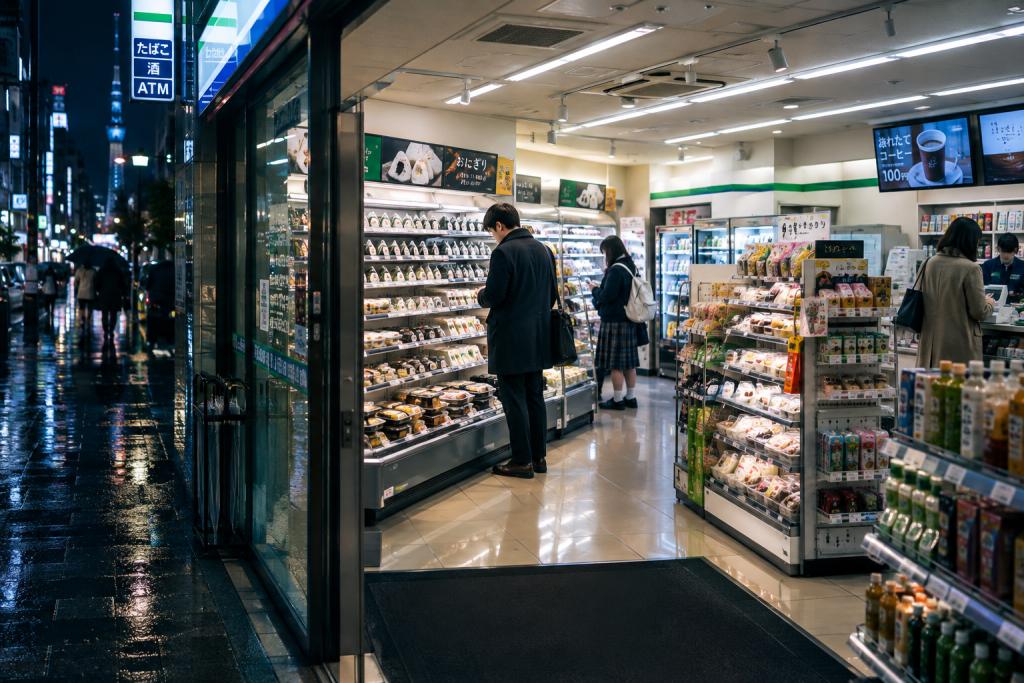
Its light is almost theatrical against a dark Tokyo street: white, precise, reassuring. Inside, shelves are immaculate. Rice balls sit in neat rows. Bento boxes wait beneath refrigerated glass. Sandwiches are wrapped with almost unnerving precision. There are cakes, puddings, coffee, bottled tea, cosmetics, stationery, umbrellas, batteries and things you did not realise you needed until five minutes ago.
A salaryman comes in for dinner.
A student buys a drink and dessert.
A traveller stands in front of the onigiri display, attempting to decode the packaging.
Someone else is there to collect a parcel.
Another customer is paying a bill.
Someone prints a document.
The remarkable thing is that none of this feels remarkable to the people using the store.
That may be the greatest achievement of the Japanese convenience store.
The konbini — the Japanese shortening of “convenience store” — has transformed an apparently modest retail format into one of the most sophisticated expressions of everyday life in Japan.
It is simultaneously food retailer, logistics node, service counter, neighbourhood facility, technology laboratory and cultural stage.
And its influence is enormous.
Seven-Eleven Japan alone had 21,927 domestic stores at the end of February 2026, while Lawson had 14,697 domestic stores and FamilyMart’s wider group reported 16,455 domestic stores at the end of August 2026. Seven-Eleven Japan says its stores receive approximately 20 million customer visits a day. Japan’s Ministry of Economy, Trade and Industry also reported that convenience-store sales increased in 2025 even as the broader retail landscape changed. [1]
The numbers explain scale.
They do not explain fascination.
For that, one has to look more closely.
What Exactly Is a Konbini?
The Japanese konbini is not simply the Japanese version of a Western convenience store.
The format has international roots, but Japan adapted it to local circumstances and pushed it far beyond the original proposition of selling everyday goods at convenient hours.
Seven-Eleven Japan began with an agreement with the American Southland Corporation in 1973, opening its first store in Toyosu, Tokyo, in May 1974. FamilyMart’s origins also reach back to a trial small-store operation in Sayama, Saitama, in 1973, while Lawson opened its first Japanese store in Toyonaka, Osaka, in June 1975. [2]
What followed was not simply expansion.
The Japanese chains developed increasingly sophisticated relationships between stores, suppliers, factories, distribution centres and information systems.
Seven-Eleven introduced POS technology in 1982. It began three-times-daily delivery of cooked-rice products in 1987 and developed temperature-control systems for those products. Lawson established a dedicated distribution centre in the late 1970s and developed shared delivery systems. FamilyMart completed a next-day delivery system in 1986. [3]
The store gradually became the visible end of a much larger machine.
And that machine was built around an unusually demanding promise:
Everything should be available, close by, reliable and increasingly good.
The Shop That Learned to Read Its Customers
The genius of the Japanese convenience store lies partly in its ability to observe.
A supermarket can sell thousands of products.
A konbini has much less space.
That constraint makes selection an art.
Every shelf has to earn its existence.
The companies therefore developed extraordinarily detailed systems for understanding what sells, where, when and to whom. POS data does not merely record transactions after they happen; it becomes part of the mechanism through which products are developed, ordered, positioned and replaced.
The result is a strange form of retail intelligence.
A store in Tokyo does not necessarily behave like one in Hokkaido.
A station-area store does not necessarily need the same assortment as one in a residential neighbourhood.
A summer evening produces different demands from a winter morning.
And the store can react.
This is why the konbini feels surprisingly alive despite its standardised appearance.
The exterior may be familiar.
The interior is constantly being edited.
The Extraordinary Food Inside an Ordinary Shop
Perhaps the most visible reason international visitors become fascinated with Japanese convenience stores is food.
There is something slightly disorienting about buying a ¥200-ish onigiri from a fluorescently lit shop and discovering that someone has clearly thought quite seriously about the rice, the filling, the texture and the packaging.
Onigiri is the perfect example.
Seven-Eleven Japan says its onigiri uses Japanese rice and that considerable attention is paid to the texture and packaging. Its wrapped onigiri is designed to preserve the crispness of the nori by keeping the seaweed separate from the rice until opening. [4]
That packaging is not decoration.
It solves a physical problem.
The customer wants the convenience of a packaged rice ball but also wants something closer to the sensory experience of freshly wrapped nori.
Seven-Eleven’s own history records the importance of this development. Its “Parikko Film” allowed customers to wrap the seaweed around the rice immediately before eating, helping transform convenience-store onigiri from an oddity into an everyday food. The company later introduced tuna-mayonnaise onigiri in 1983, a combination that became one of the category’s enduring classics. [5]
The lesson is larger than onigiri.
The konbini did not merely package existing Japanese food.
It redesigned food for modern life.
Bento became portable.
Rice became a retail product.
Sandwiches became precision objects.
Desserts became seasonal events.
Hot food became part of the everyday commute.
Why the Food Feels So Considered
A Japanese convenience-store sandwich is not necessarily competing with a Michelin-starred kitchen.
It is competing with the expectations of Japanese consumers.
That distinction matters.
The achievement is not that every konbini meal is extraordinary.
It is that an enormous retail system can repeatedly deliver food that is fresh enough, attractive enough, affordable enough and consistent enough to become part of ordinary life.
The chains constantly revise recipes, packaging, portion sizes and ingredients.
Lawson’s current product mix, for example, includes rice meals, fast food, in-store kitchen products, bakery products and desserts, with recent product performance including collaborations with established food brands. [6]
FamilyMart similarly continues to use its scale to create limited products and collaborations. In 2026, it expanded its Tokyo Banana collaboration into seven dessert and ice-cream products across Japan and Taiwan. [7]
This is where the konbini begins to resemble fashion.
There is a permanent appetite for newness.
A product arrives.
It is photographed.
People talk about it.
It sells.
Then it disappears.
The consumer returns to see what has replaced it.
The Logistics Behind the Illusion
The shelf is the visible part.
The logistics are the invisible achievement.
A packaged sandwich may appear to be a simple object, but keeping thousands of stores supplied with fresh food requires careful coordination between manufacturing, temperature control, delivery schedules, inventory and demand forecasting.
The chains have historically built their businesses around precisely this problem.
Seven-Eleven’s early history records joint supplier delivery beginning in 1975, temperature-controlled systems for cooked rice, and multiple daily deliveries of cooked-rice products. [8]
The model is now being redesigned again.
FamilyMart announced in 2025 that it was moving certain deliveries of onigiri, bento, bread, side dishes and desserts in Hokuriku from three temperature-controlled deliveries a day to two, while reorganising production and delivery routes to improve efficiency and reduce CO₂ emissions and food loss. [9]
Lawson has likewise been reducing delivery frequency for chilled and ambient-temperature products and using route optimisation. The company says average daily delivery vehicles per store, excluding newspapers, books, magazines and tobacco, had fallen from 16 in 1989 to five by February 2026. It is also using AI to optimise delivery schedules. [10]
This is the paradox of convenience.
The simpler the experience feels to the customer, the more complicated the system behind it may be.
Seasonality in a Plastic Wrapper
One of the most charming characteristics of the Japanese konbini is that it changes with the calendar.
The shelves are not merely stocked.
They are edited according to the season.
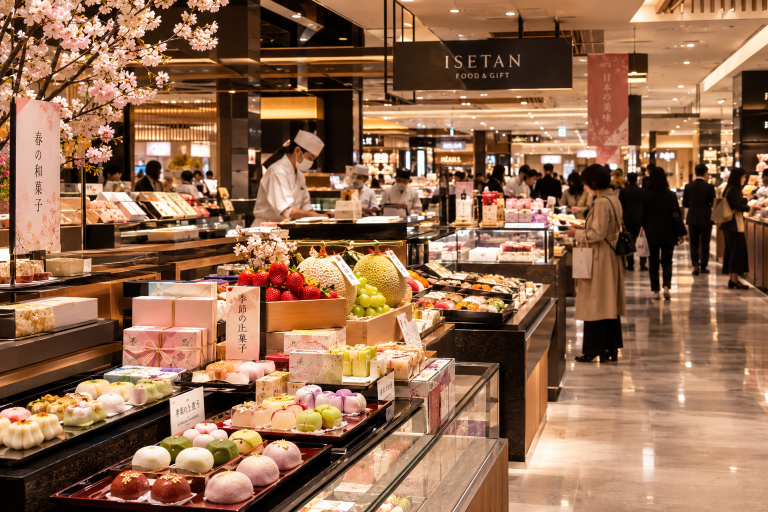
Sakura flavours appear in spring.
Summer brings fruit, chilled desserts and lighter flavours.
Autumn introduces chestnut, pumpkin and sweet potato.
Winter brings richer desserts, hot foods and New Year-related products.
There are regional products, holiday campaigns, limited flavours and collaborations.
Seven-Eleven’s current product catalogue explicitly separates products by Japanese region, while warning that products can vary by location and may disappear when supply runs out. [11]
FamilyMart has been pursuing regional product development for decades, with its corporate history describing “regional marketing” based on local tastes and locally sourced ingredients. [12]
This is one reason the konbini can feel strangely close to a fashion boutique.
The underlying product category remains familiar.
The assortment keeps moving.
The consumer is not only buying food.
They are checking what is new.
The Psychology of “Limited”
Convenience stores understand scarcity.
A seasonal dessert does not need to be rare in the traditional luxury sense.
It only needs to be temporary.
That creates a subtle psychological mechanism.
The customer thinks:
If I don’t buy it now, it may not be here next time.
The effect is powerful because the store is everywhere.
A luxury boutique might create scarcity through exclusivity and price.
The konbini can create scarcity through time.
The product may be affordable, but the moment is limited.
This helps explain why convenience stores can become destinations for people who technically have nothing they need to buy.
They go to look.
That distinction is culturally important.
A shop becomes entertainment when discovery itself becomes part of the experience.
The Art of Packaging
Japanese convenience-store packaging deserves more attention than it usually receives.
The best examples are small exercises in industrial design.
There is typography.
Colour coding.
Ingredient information.
Opening instructions.
Temperature information.
Portion control.
Material choices.
And, in products such as onigiri, packaging has to solve a mechanical problem while remaining intuitive enough to understand in seconds.
Seven-Eleven has repeatedly redesigned onigiri packaging to improve usability and reduce material use. In one major redesign, the company reported a reduction of roughly 20% in plastic use while continuing to focus on rice, nori and filling quality. [13]
This is where Japanese packaging culture becomes especially interesting.
The disposable object is not automatically treated as an unimportant object.
It is still designed.
But that success contains an uncomfortable contradiction.
The more convenient the system becomes, the more packaging it can generate.
The konbini’s brilliance and its environmental burden are therefore inseparable.
Convenience as Hospitality
There is another reason visitors often find Japanese convenience stores unusually pleasant.
They are designed to reduce friction.
The store is clean.
The products are legible.
The floor plan is familiar.
Food can often be heated.
Payment is straightforward.
There are ATMs.
There may be parcel services, printing and ticketing.
The staff are expected to execute a remarkable number of small tasks accurately.
It is tempting to explain all of this through the Japanese concept of omotenashi.
But that would be too easy.
Not every operational decision is an expression of hospitality philosophy.
Much of it is simply the result of rigorous retail engineering.
Yet the customer experiences the result as care.
That distinction matters.
Hospitality does not always have to be theatrical.
Sometimes hospitality is simply making sure that the thing works.
The Konbini as Urban Infrastructure
This is where the convenience store becomes considerably more interesting than a retailer.
A Japanese convenience store can be an ATM, parcel collection point, payment centre, ticketing facility and printing station in addition to being a shop.
Seven-Eleven’s service network includes parcel lockers and collection services, 7NOW delivery, postal products and other services. [14]
NewDays, the convenience format operated by JR East Cross Station, demonstrates another variation: its stores are integrated into railway stations and offer services including ATM access, bill-payment services, parcel handling and electronic-payment infrastructure. [15]
The convenience store therefore occupies a peculiar position between private enterprise and public utility.
It is commercially operated.
But its usefulness extends beyond commerce.
The Japanese government has recognised this role.
Lawson describes its stores as part of the local “lifeline” and maintains agreements with municipalities concerning emergency supplies and support for people unable to return home after disasters. Its disaster-response system includes measures designed to keep stores operating and restore them quickly. [16]
FamilyMart likewise maintains agreements with municipalities for emergency supplies including food, water, clothing, batteries and other everyday necessities. [17]
During a disaster, the convenience store can suddenly become something else.
The shop becomes infrastructure.
The Lights That Stay On
There is an emotional quality to the brightly illuminated konbini at night.
Not because it is particularly beautiful.
Because it is dependable.
In a city where many things close, the light remains.
Seven-Eleven’s own history describes the illuminated 24-hour store as having become part of the reassuring landscape of neighbourhoods. [18]
That observation is revealing.
Convenience is not only about speed.
It can also mean psychological availability.
You know something will probably be there.
You know where it is.
You know roughly what it will look like.
That predictability has value.
A 2019 academic study of young Japanese consumers found that accessibility, location and the atmosphere of convenience stores contributed to their appeal and sense of well-being. [19]
The konbini can therefore be understood as a small zone of dependable order inside a complicated city.
7-Eleven, FamilyMart and Lawson: Three Versions of Convenience
The major chains share a common infrastructure but have developed distinctive personalities.
Seven-Eleven has historically been particularly associated with data-driven retail, private-label development and intense attention to fresh food. Its domestic business recorded ¥5.469 trillion in chain-wide sales for fiscal 2026 and operated 21,927 Japanese stores at the end of February 2026. [20]
FamilyMart operates at comparable scale, reporting 16,455 domestic stores across its Japanese network at the end of August 2026. Its brand has long emphasised the relationship between convenience and everyday companionship — “you and convenience, FamilyMart” — while its product strategy includes private-label food, regional products and collaborations. [21]
Lawson has developed its own ecosystem around food, desserts, Karaage-kun, Natural Lawson and increasingly experimental retail technology. Its domestic network stood at 14,697 stores at the end of February 2026. [22]
There is no meaningful need to declare one the “best.”
The competition is more interesting than that.
Each chain is trying to answer the same question differently:
What should convenience mean next?
Pop Culture in the Aisle
The konbini is also perfectly suited to Japanese pop culture.
Anime, manga, gaming, musicians, television programmes and character franchises can become temporary retail campaigns.
The mechanism is beautifully simple.
The stores are geographically ubiquitous.
The products are inexpensive enough to encourage impulse purchases.
The campaigns are time-limited.
The merchandise can be collectible.
And the audience is already accustomed to checking stores regularly.
A collaboration therefore does not need a huge standalone shop.
The entire country can become the distribution network.
The result is a retail format that behaves partly like media.
A character appears on a dessert.
A promotional campaign introduces a collectible.
A limited package becomes an object of interest.
The consumer is no longer simply buying something.
They are participating in a cultural moment.
For Tourists, Routine Becomes Revelation
For a Japanese resident, buying an onigiri before work is hardly an anthropological event.
For a first-time visitor, it can be.
This is one of the most fascinating aspects of konbini culture.
Tourists encounter an ordinary institution and experience it as an attraction.
They photograph shelves.
They compare chains.
They try desserts.
They talk about egg sandwiches.
They discover regional snacks.
They are fascinated by the sheer density of services available under one roof.
The reason is not simply that the products are good.
It is that the store reveals something about how another society organises ordinary life.
A traveller visiting a museum learns what a culture considers worthy of preservation.
A traveller visiting a konbini learns something about what a culture expects from everyday infrastructure.
That may be even more revealing.
A Miniature Map of Japan
The national convenience-store chains are also capable of expressing regional identity.
A chain may alter products according to local tastes and ingredients.
FamilyMart’s long-running regional development programmes have explicitly used local ingredients and regional preferences to create products for different parts of Japan. [23]
Seven-Eleven’s product catalogue is likewise organised by regional availability.
This matters because Japan is often discussed internationally as if its food culture were a single unified thing.
It is not.
Hokkaido tastes different from Kyushu.
Kansai has its own culinary vocabulary.
Okinawa has another.
The convenience store compresses some of that diversity into a refrigerator shelf.
It is not a substitute for regional cuisine.
But it can be a surprisingly effective introduction to it.
The Working Life of a Konbini
The convenience store also mirrors the structure of modern Japanese life.
It serves commuters.
Students.
Office workers.
Single-person households.
Older consumers.
Night workers.
Travellers.
Families who need one missing ingredient.
The format grew alongside urbanisation and changing lifestyles, and its continued relevance is now being tested by a different demographic reality: Japan is ageing and its working-age population is under pressure.
That creates an irony.
The system was built to provide more convenience.
But providing that convenience requires people.
Someone must replenish the shelves.
Someone must unload deliveries.
Someone must prepare food.
Someone must clean.
Someone must operate the store through the night.
The modern konbini is therefore confronting the same labour question affecting much of Japanese society:
How do you maintain an extremely high standard of service when there are fewer people available to provide it?
When Convenience Becomes Too Convenient
The darker side of the konbini is unavoidable.
Freshness means waste risk.
Constant refrigeration consumes energy.
Individual portions require packaging.
Frequent deliveries create logistical demands.
Long opening hours require labour.
And franchise operators can face intense commercial pressures.
The Japanese convenience-store system has consequently spent years trying to redesign the economics of convenience itself.
Lawson reported that its stores generated an average of 41.6 kilograms of waste per store per day in fiscal 2025, including 8.6 kilograms of unsold food. The company says its 2025 food-waste level was 20% lower than its 2018 baseline under its current measurement system. [24]
FamilyMart uses markdown programmes for food approaching its sell-by period and has promoted “tearful” discount stickers as part of its food-waste reduction efforts. [25]
These measures are practical rather than glamorous.
That is appropriate.
The environmental problem cannot be solved through attractive packaging alone.
The Packaging Contradiction
The same industry that has perfected packaging is now trying to reduce it.
Lawson reported that its original-product plastic packaging weight had fallen significantly from its 2017 baseline and has been replacing, thinning or redesigning packaging materials. The company has also introduced smaller or redesigned labels and paper containers in some product categories. [26]
Yet convenience retail remains inherently packaging-intensive.
A single serving is useful because it is portable, hygienic and easy to store.
Those same characteristics create waste.
The question is therefore not whether the konbini can become perfectly sustainable.
It is whether the system can preserve its extraordinary convenience while reducing the environmental cost of providing it.
That is a much harder problem.
And an important one.
The Next Konbini Is Already Arriving
The future of Japanese convenience retail is becoming increasingly technological.
Lawson and KDDI have been experimenting with “Real × Tech LAWSON” stores in Tokyo, combining digital signage, remote customer service, robotics and AI. One of the experimental stores uses AI and robotic systems to detect shelf shortages and automate product replenishment. [27]
Lawson has also experimented with walk-through payment, where customers can take products and leave without using a conventional checkout. [28]
These experiments respond to a very real problem: labour scarcity.
Technology can reduce repetitive work.
AI can help forecast demand.
Robots can replenish shelves.
Digital systems can reduce queues.
Inventory can become more precise.
But the technological question is also cultural.
What happens when the convenience store becomes almost entirely frictionless?
The traditional konbini is unusually human in appearance despite its highly automated back end.
There is a person behind the counter.
Someone says irasshaimase.
Someone heats the food.
Someone hands you the bag.
If the next generation removes most of those interactions, will convenience become colder?
Or will technology simply free workers to perform the parts of the service that still require people?
Japan is now conducting that experiment in public.
The Luxury Hidden in Ordinary Things
This is perhaps where the konbini becomes unexpectedly relevant to a publication like The Scarlet Kingdom.
Luxury is usually associated with rarity.
But another definition of luxury is the extraordinary execution of something ordinary.
A perfectly fresh meal at an inconvenient hour.
A product that opens exactly as intended.
A store that is clean when you need it.
A parcel waiting when you arrive.
A payment completed in minutes.
A seasonal dessert that tastes exactly as promised.
None of these things is luxurious in price.
But they can be luxurious in execution.
The Japanese convenience store demonstrates that quality does not always require exclusivity.
Sometimes quality means refusing to accept that an inexpensive object should be badly designed.
That may be one of the most interesting lessons hidden inside the konbini.
How to Experience a Konbini Like an Insider
The best way to visit a Japanese convenience store is not to arrive with a shopping list.
Arrive curious.
Go early in the morning and look at the breakfast selection.
Visit again late at night.
Notice how different the store feels.
Look beyond the famous products.
Compare onigiri.
Look at the regional labels.
Watch how the packaging opens.
Try a dessert.
Look at the hot-food counter.
Notice the services around the checkout.
And resist the temptation to buy everything simply because it is unfamiliar.
The real pleasure is observation.
A konbini is one of the rare places where a visitor can learn about a society without entering a museum.
The lesson is sitting in the refrigerator.
The Shop That Became a Culture
Late at night, the convenience store looks almost exactly as it did at the beginning of the evening.
The lights remain on.
The shelves are being replenished.
The refrigerators hum.
A commuter buys breakfast for tomorrow.
A student chooses a dessert.
A traveller examines an onigiri with the concentration normally reserved for fine wine.
A parcel is collected.
A bill is paid.
Life continues.
And that is precisely why the Japanese convenience store became a cultural phenomenon.
It did not become famous by trying to become an attraction.
It became fascinating because it took ordinary life seriously.
It applied logistics to freshness, technology to convenience, design to packaging, data to merchandising, seasonal awareness to mass retail and service thinking to the smallest transactions.
It created a system in which an inexpensive meal could be thoughtfully designed, a neighbourhood shop could become disaster infrastructure, and a fluorescently lit corner store could become an unofficial introduction to Japanese food culture.
The deeper achievement of the konbini is therefore not convenience itself.
It is reliability.
The promise that something useful will be there.
That the rice will be good enough.
That the packaging will work.
That the store will be clean.
That the product will be replaced when the season changes.
That the city will keep moving.
Japan’s convenience stores reveal a society in which the ordinary is not necessarily treated as disposable in the cultural sense.
It can be engineered.
Refined.
Reconsidered.
Improved.
And perhaps that is why the konbini has travelled so far in the imagination of the world.
It suggests a deceptively simple idea:
Everyday life deserves good design too.
Why Japanese Convenience Stores Have Become a Cultural Phenomenon
Japan’s konbini is more than a shop. It is a piece of urban infrastructure, a food laboratory, a logistics network, a service counter and, increasingly, a cultural institution.
At night, when much of a city has begun to retreat behind apartment doors, the Japanese convenience store remains awake.
Its light is almost theatrical against a dark Tokyo street: white, precise, reassuring. Inside, shelves are immaculate. Rice balls sit in neat rows. Bento boxes wait beneath refrigerated glass. Sandwiches are wrapped with almost unnerving precision. There are cakes, puddings, coffee, bottled tea, cosmetics, stationery, umbrellas, batteries and things you did not realise you needed until five minutes ago.
A salaryman comes in for dinner.
A student buys a drink and dessert.
A traveller stands in front of the onigiri display, attempting to decode the packaging.
Someone else is there to collect a parcel.
Another customer is paying a bill.
Someone prints a document.
The remarkable thing is that none of this feels remarkable to the people using the store.
That may be the greatest achievement of the Japanese convenience store.
The konbini — the Japanese shortening of “convenience store” — has transformed an apparently modest retail format into one of the most sophisticated expressions of everyday life in Japan.
It is simultaneously food retailer, logistics node, service counter, neighbourhood facility, technology laboratory and cultural stage.
And its influence is enormous.
Seven-Eleven Japan alone had 21,927 domestic stores at the end of February 2026, while Lawson had 14,697 domestic stores and FamilyMart’s wider group reported 16,455 domestic stores at the end of August 2026. Seven-Eleven Japan says its stores receive approximately 20 million customer visits a day. Japan’s Ministry of Economy, Trade and Industry also reported that convenience-store sales increased in 2025 even as the broader retail landscape changed. [1]
The numbers explain scale.
They do not explain fascination.
For that, one has to look more closely.
What Exactly Is a Konbini?
The Japanese konbini is not simply the Japanese version of a Western convenience store.
The format has international roots, but Japan adapted it to local circumstances and pushed it far beyond the original proposition of selling everyday goods at convenient hours.
Seven-Eleven Japan began with an agreement with the American Southland Corporation in 1973, opening its first store in Toyosu, Tokyo, in May 1974. FamilyMart’s origins also reach back to a trial small-store operation in Sayama, Saitama, in 1973, while Lawson opened its first Japanese store in Toyonaka, Osaka, in June 1975. [2]
What followed was not simply expansion.
The Japanese chains developed increasingly sophisticated relationships between stores, suppliers, factories, distribution centres and information systems.
Seven-Eleven introduced POS technology in 1982. It began three-times-daily delivery of cooked-rice products in 1987 and developed temperature-control systems for those products. Lawson established a dedicated distribution centre in the late 1970s and developed shared delivery systems. FamilyMart completed a next-day delivery system in 1986. [3]
The store gradually became the visible end of a much larger machine.
And that machine was built around an unusually demanding promise:
Everything should be available, close by, reliable and increasingly good.
The Shop That Learned to Read Its Customers
The genius of the Japanese convenience store lies partly in its ability to observe.
A supermarket can sell thousands of products.
A konbini has much less space.
That constraint makes selection an art.
Every shelf has to earn its existence.
The companies therefore developed extraordinarily detailed systems for understanding what sells, where, when and to whom. POS data does not merely record transactions after they happen; it becomes part of the mechanism through which products are developed, ordered, positioned and replaced.
The result is a strange form of retail intelligence.
A store in Tokyo does not necessarily behave like one in Hokkaido.
A station-area store does not necessarily need the same assortment as one in a residential neighbourhood.
A summer evening produces different demands from a winter morning.
And the store can react.
This is why the konbini feels surprisingly alive despite its standardised appearance.
The exterior may be familiar.
The interior is constantly being edited.
The Extraordinary Food Inside an Ordinary Shop
Perhaps the most visible reason international visitors become fascinated with Japanese convenience stores is food.
There is something slightly disorienting about buying a ¥200-ish onigiri from a fluorescently lit shop and discovering that someone has clearly thought quite seriously about the rice, the filling, the texture and the packaging.
Onigiri is the perfect example.
Seven-Eleven Japan says its onigiri uses Japanese rice and that considerable attention is paid to the texture and packaging. Its wrapped onigiri is designed to preserve the crispness of the nori by keeping the seaweed separate from the rice until opening. [4]
That packaging is not decoration.
It solves a physical problem.
The customer wants the convenience of a packaged rice ball but also wants something closer to the sensory experience of freshly wrapped nori.
Seven-Eleven’s own history records the importance of this development. Its “Parikko Film” allowed customers to wrap the seaweed around the rice immediately before eating, helping transform convenience-store onigiri from an oddity into an everyday food. The company later introduced tuna-mayonnaise onigiri in 1983, a combination that became one of the category’s enduring classics. [5]
The lesson is larger than onigiri.
The konbini did not merely package existing Japanese food.
It redesigned food for modern life.
Bento became portable.
Rice became a retail product.
Sandwiches became precision objects.
Desserts became seasonal events.
Hot food became part of the everyday commute.
Why the Food Feels So Considered
A Japanese convenience-store sandwich is not necessarily competing with a Michelin-starred kitchen.
It is competing with the expectations of Japanese consumers.
That distinction matters.
The achievement is not that every konbini meal is extraordinary.
It is that an enormous retail system can repeatedly deliver food that is fresh enough, attractive enough, affordable enough and consistent enough to become part of ordinary life.
The chains constantly revise recipes, packaging, portion sizes and ingredients.
Lawson’s current product mix, for example, includes rice meals, fast food, in-store kitchen products, bakery products and desserts, with recent product performance including collaborations with established food brands. [6]
FamilyMart similarly continues to use its scale to create limited products and collaborations. In 2026, it expanded its Tokyo Banana collaboration into seven dessert and ice-cream products across Japan and Taiwan. [7]
This is where the konbini begins to resemble fashion.
There is a permanent appetite for newness.
A product arrives.
It is photographed.
People talk about it.
It sells.
Then it disappears.
The consumer returns to see what has replaced it.
The Logistics Behind the Illusion
The shelf is the visible part.
The logistics are the invisible achievement.
A packaged sandwich may appear to be a simple object, but keeping thousands of stores supplied with fresh food requires careful coordination between manufacturing, temperature control, delivery schedules, inventory and demand forecasting.
The chains have historically built their businesses around precisely this problem.
Seven-Eleven’s early history records joint supplier delivery beginning in 1975, temperature-controlled systems for cooked rice, and multiple daily deliveries of cooked-rice products. [8]
The model is now being redesigned again.
FamilyMart announced in 2025 that it was moving certain deliveries of onigiri, bento, bread, side dishes and desserts in Hokuriku from three temperature-controlled deliveries a day to two, while reorganising production and delivery routes to improve efficiency and reduce CO₂ emissions and food loss. [9]
Lawson has likewise been reducing delivery frequency for chilled and ambient-temperature products and using route optimisation. The company says average daily delivery vehicles per store, excluding newspapers, books, magazines and tobacco, had fallen from 16 in 1989 to five by February 2026. It is also using AI to optimise delivery schedules. [10]
This is the paradox of convenience.
The simpler the experience feels to the customer, the more complicated the system behind it may be.
Seasonality in a Plastic Wrapper
One of the most charming characteristics of the Japanese konbini is that it changes with the calendar.
The shelves are not merely stocked.
They are edited according to the season.
Sakura flavours appear in spring.
Summer brings fruit, chilled desserts and lighter flavours.
Autumn introduces chestnut, pumpkin and sweet potato.
Winter brings richer desserts, hot foods and New Year-related products.
There are regional products, holiday campaigns, limited flavours and collaborations.
Seven-Eleven’s current product catalogue explicitly separates products by Japanese region, while warning that products can vary by location and may disappear when supply runs out. [11]
FamilyMart has been pursuing regional product development for decades, with its corporate history describing “regional marketing” based on local tastes and locally sourced ingredients. [12]
This is one reason the konbini can feel strangely close to a fashion boutique.
The underlying product category remains familiar.
The assortment keeps moving.
The consumer is not only buying food.
They are checking what is new.
The Psychology of “Limited”
Convenience stores understand scarcity.
A seasonal dessert does not need to be rare in the traditional luxury sense.
It only needs to be temporary.
That creates a subtle psychological mechanism.
The customer thinks:
If I don’t buy it now, it may not be here next time.
The effect is powerful because the store is everywhere.
A luxury boutique might create scarcity through exclusivity and price.
The konbini can create scarcity through time.
The product may be affordable, but the moment is limited.
This helps explain why convenience stores can become destinations for people who technically have nothing they need to buy.
They go to look.
That distinction is culturally important.
A shop becomes entertainment when discovery itself becomes part of the experience.
The Art of Packaging
Japanese convenience-store packaging deserves more attention than it usually receives.
The best examples are small exercises in industrial design.
There is typography.
Colour coding.
Ingredient information.
Opening instructions.
Temperature information.
Portion control.
Material choices.
And, in products such as onigiri, packaging has to solve a mechanical problem while remaining intuitive enough to understand in seconds.
Seven-Eleven has repeatedly redesigned onigiri packaging to improve usability and reduce material use. In one major redesign, the company reported a reduction of roughly 20% in plastic use while continuing to focus on rice, nori and filling quality. [13]
This is where Japanese packaging culture becomes especially interesting.
The disposable object is not automatically treated as an unimportant object.
It is still designed.
But that success contains an uncomfortable contradiction.
The more convenient the system becomes, the more packaging it can generate.
The konbini’s brilliance and its environmental burden are therefore inseparable.
Convenience as Hospitality
There is another reason visitors often find Japanese convenience stores unusually pleasant.
They are designed to reduce friction.
The store is clean.
The products are legible.
The floor plan is familiar.
Food can often be heated.
Payment is straightforward.
There are ATMs.
There may be parcel services, printing and ticketing.
The staff are expected to execute a remarkable number of small tasks accurately.
It is tempting to explain all of this through the Japanese concept of omotenashi.
But that would be too easy.
Not every operational decision is an expression of hospitality philosophy.
Much of it is simply the result of rigorous retail engineering.
Yet the customer experiences the result as care.
That distinction matters.
Hospitality does not always have to be theatrical.
Sometimes hospitality is simply making sure that the thing works.
The Konbini as Urban Infrastructure
This is where the convenience store becomes considerably more interesting than a retailer.
A Japanese convenience store can be an ATM, parcel collection point, payment centre, ticketing facility and printing station in addition to being a shop.
Seven-Eleven’s service network includes parcel lockers and collection services, 7NOW delivery, postal products and other services. [14]
NewDays, the convenience format operated by JR East Cross Station, demonstrates another variation: its stores are integrated into railway stations and offer services including ATM access, bill-payment services, parcel handling and electronic-payment infrastructure. [15]
The convenience store therefore occupies a peculiar position between private enterprise and public utility.
It is commercially operated.
But its usefulness extends beyond commerce.
The Japanese government has recognised this role.
Lawson describes its stores as part of the local “lifeline” and maintains agreements with municipalities concerning emergency supplies and support for people unable to return home after disasters. Its disaster-response system includes measures designed to keep stores operating and restore them quickly. [16]
FamilyMart likewise maintains agreements with municipalities for emergency supplies including food, water, clothing, batteries and other everyday necessities. [17]
During a disaster, the convenience store can suddenly become something else.
The shop becomes infrastructure.
The Lights That Stay On
There is an emotional quality to the brightly illuminated konbini at night.
Not because it is particularly beautiful.
Because it is dependable.
In a city where many things close, the light remains.
Seven-Eleven’s own history describes the illuminated 24-hour store as having become part of the reassuring landscape of neighbourhoods. [18]
That observation is revealing.
Convenience is not only about speed.
It can also mean psychological availability.
You know something will probably be there.
You know where it is.
You know roughly what it will look like.
That predictability has value.
A 2019 academic study of young Japanese consumers found that accessibility, location and the atmosphere of convenience stores contributed to their appeal and sense of well-being. [19]
The konbini can therefore be understood as a small zone of dependable order inside a complicated city.
7-Eleven, FamilyMart and Lawson: Three Versions of Convenience
The major chains share a common infrastructure but have developed distinctive personalities.
Seven-Eleven has historically been particularly associated with data-driven retail, private-label development and intense attention to fresh food. Its domestic business recorded ¥5.469 trillion in chain-wide sales for fiscal 2026 and operated 21,927 Japanese stores at the end of February 2026. [20]
FamilyMart operates at comparable scale, reporting 16,455 domestic stores across its Japanese network at the end of August 2026. Its brand has long emphasised the relationship between convenience and everyday companionship — “you and convenience, FamilyMart” — while its product strategy includes private-label food, regional products and collaborations. [21]
Lawson has developed its own ecosystem around food, desserts, Karaage-kun, Natural Lawson and increasingly experimental retail technology. Its domestic network stood at 14,697 stores at the end of February 2026. [22]
There is no meaningful need to declare one the “best.”
The competition is more interesting than that.
Each chain is trying to answer the same question differently:
What should convenience mean next?
Pop Culture in the Aisle
The konbini is also perfectly suited to Japanese pop culture.
Anime, manga, gaming, musicians, television programmes and character franchises can become temporary retail campaigns.
The mechanism is beautifully simple.
The stores are geographically ubiquitous.
The products are inexpensive enough to encourage impulse purchases.
The campaigns are time-limited.
The merchandise can be collectible.
And the audience is already accustomed to checking stores regularly.
A collaboration therefore does not need a huge standalone shop.
The entire country can become the distribution network.
The result is a retail format that behaves partly like media.
A character appears on a dessert.
A promotional campaign introduces a collectible.
A limited package becomes an object of interest.
The consumer is no longer simply buying something.
They are participating in a cultural moment.
For Tourists, Routine Becomes Revelation
For a Japanese resident, buying an onigiri before work is hardly an anthropological event.
For a first-time visitor, it can be.
This is one of the most fascinating aspects of konbini culture.
Tourists encounter an ordinary institution and experience it as an attraction.
They photograph shelves.
They compare chains.
They try desserts.
They talk about egg sandwiches.
They discover regional snacks.
They are fascinated by the sheer density of services available under one roof.
The reason is not simply that the products are good.
It is that the store reveals something about how another society organises ordinary life.
A traveller visiting a museum learns what a culture considers worthy of preservation.
A traveller visiting a konbini learns something about what a culture expects from everyday infrastructure.
That may be even more revealing.
A Miniature Map of Japan
The national convenience-store chains are also capable of expressing regional identity.
A chain may alter products according to local tastes and ingredients.
FamilyMart’s long-running regional development programmes have explicitly used local ingredients and regional preferences to create products for different parts of Japan. [23]
Seven-Eleven’s product catalogue is likewise organised by regional availability.
This matters because Japan is often discussed internationally as if its food culture were a single unified thing.
It is not.
Hokkaido tastes different from Kyushu.
Kansai has its own culinary vocabulary.
Okinawa has another.
The convenience store compresses some of that diversity into a refrigerator shelf.
It is not a substitute for regional cuisine.
But it can be a surprisingly effective introduction to it.
The Working Life of a Konbini
The convenience store also mirrors the structure of modern Japanese life.
It serves commuters.
Students.
Office workers.
Single-person households.
Older consumers.
Night workers.
Travellers.
Families who need one missing ingredient.
The format grew alongside urbanisation and changing lifestyles, and its continued relevance is now being tested by a different demographic reality: Japan is ageing and its working-age population is under pressure.
That creates an irony.
The system was built to provide more convenience.
But providing that convenience requires people.
Someone must replenish the shelves.
Someone must unload deliveries.
Someone must prepare food.
Someone must clean.
Someone must operate the store through the night.
The modern konbini is therefore confronting the same labour question affecting much of Japanese society:
How do you maintain an extremely high standard of service when there are fewer people available to provide it?
When Convenience Becomes Too Convenient
The darker side of the konbini is unavoidable.
Freshness means waste risk.
Constant refrigeration consumes energy.
Individual portions require packaging.
Frequent deliveries create logistical demands.
Long opening hours require labour.
And franchise operators can face intense commercial pressures.
The Japanese convenience-store system has consequently spent years trying to redesign the economics of convenience itself.
Lawson reported that its stores generated an average of 41.6 kilograms of waste per store per day in fiscal 2025, including 8.6 kilograms of unsold food. The company says its 2025 food-waste level was 20% lower than its 2018 baseline under its current measurement system. [24]
FamilyMart uses markdown programmes for food approaching its sell-by period and has promoted “tearful” discount stickers as part of its food-waste reduction efforts. [25]
These measures are practical rather than glamorous.
That is appropriate.
The environmental problem cannot be solved through attractive packaging alone.
The Packaging Contradiction
The same industry that has perfected packaging is now trying to reduce it.
Lawson reported that its original-product plastic packaging weight had fallen significantly from its 2017 baseline and has been replacing, thinning or redesigning packaging materials. The company has also introduced smaller or redesigned labels and paper containers in some product categories. [26]
Yet convenience retail remains inherently packaging-intensive.
A single serving is useful because it is portable, hygienic and easy to store.
Those same characteristics create waste.
The question is therefore not whether the konbini can become perfectly sustainable.
It is whether the system can preserve its extraordinary convenience while reducing the environmental cost of providing it.
That is a much harder problem.
And an important one.
The Next Konbini Is Already Arriving
The future of Japanese convenience retail is becoming increasingly technological.
Lawson and KDDI have been experimenting with “Real × Tech LAWSON” stores in Tokyo, combining digital signage, remote customer service, robotics and AI. One of the experimental stores uses AI and robotic systems to detect shelf shortages and automate product replenishment. [27]
Lawson has also experimented with walk-through payment, where customers can take products and leave without using a conventional checkout. [28]
These experiments respond to a very real problem: labour scarcity.
Technology can reduce repetitive work.
AI can help forecast demand.
Robots can replenish shelves.
Digital systems can reduce queues.
Inventory can become more precise.
But the technological question is also cultural.
What happens when the convenience store becomes almost entirely frictionless?
The traditional konbini is unusually human in appearance despite its highly automated back end.
There is a person behind the counter.
Someone says irasshaimase.
Someone heats the food.
Someone hands you the bag.
If the next generation removes most of those interactions, will convenience become colder?
Or will technology simply free workers to perform the parts of the service that still require people?
Japan is now conducting that experiment in public.
The Luxury Hidden in Ordinary Things
This is perhaps where the konbini becomes unexpectedly relevant to a publication like The Scarlet Kingdom.
Luxury is usually associated with rarity.
But another definition of luxury is the extraordinary execution of something ordinary.
A perfectly fresh meal at an inconvenient hour.
A product that opens exactly as intended.
A store that is clean when you need it.
A parcel waiting when you arrive.
A payment completed in minutes.
A seasonal dessert that tastes exactly as promised.
None of these things is luxurious in price.
But they can be luxurious in execution.
The Japanese convenience store demonstrates that quality does not always require exclusivity.
Sometimes quality means refusing to accept that an inexpensive object should be badly designed.
That may be one of the most interesting lessons hidden inside the konbini.
How to Experience a Konbini Like an Insider
The best way to visit a Japanese convenience store is not to arrive with a shopping list.
Arrive curious.
Go early in the morning and look at the breakfast selection.
Visit again late at night.
Notice how different the store feels.
Look beyond the famous products.
Compare onigiri.
Look at the regional labels.
Watch how the packaging opens.
Try a dessert.
Look at the hot-food counter.
Notice the services around the checkout.
And resist the temptation to buy everything simply because it is unfamiliar.
The real pleasure is observation.
A konbini is one of the rare places where a visitor can learn about a society without entering a museum.
The lesson is sitting in the refrigerator.
The Shop That Became a Culture
Late at night, the convenience store looks almost exactly as it did at the beginning of the evening.
The lights remain on.
The shelves are being replenished.
The refrigerators hum.
A commuter buys breakfast for tomorrow.
A student chooses a dessert.
A traveller examines an onigiri with the concentration normally reserved for fine wine.
A parcel is collected.
A bill is paid.
Life continues.
And that is precisely why the Japanese convenience store became a cultural phenomenon.
It did not become famous by trying to become an attraction.
It became fascinating because it took ordinary life seriously.
It applied logistics to freshness, technology to convenience, design to packaging, data to merchandising, seasonal awareness to mass retail and service thinking to the smallest transactions.
It created a system in which an inexpensive meal could be thoughtfully designed, a neighbourhood shop could become disaster infrastructure, and a fluorescently lit corner store could become an unofficial introduction to Japanese food culture.
The deeper achievement of the konbini is therefore not convenience itself.
It is reliability.
The promise that something useful will be there.
That the rice will be good enough.
That the packaging will work.
That the store will be clean.
That the product will be replaced when the season changes.
That the city will keep moving.
Japan’s convenience stores reveal a society in which the ordinary is not necessarily treated as disposable in the cultural sense.
It can be engineered.
Refined.
Reconsidered.
Improved.
And perhaps that is why the konbini has travelled so far in the imagination of the world.
It suggests a deceptively simple idea:
Everyday life deserves good design too.