
In an age where boredom feels almost extinct, many people have forgotten something important: boredom is not the enemy.
Luxury is often misunderstood as something that can be bought—a watch, a vacation, a penthouse overlooking a glittering skyline. Yet some of life’s greatest luxuries cost absolutely nothing. Time. Curiosity. Attention. The freedom to wander without purpose.
The modern world has created an endless supply of distractions. We scroll before we think. We stream before we reflect. We consume before we create. The result is a strange paradox: despite having infinite entertainment available at our fingertips, many people feel more bored than ever.
Perhaps boredom isn’t a problem to solve.
Perhaps it is an invitation.
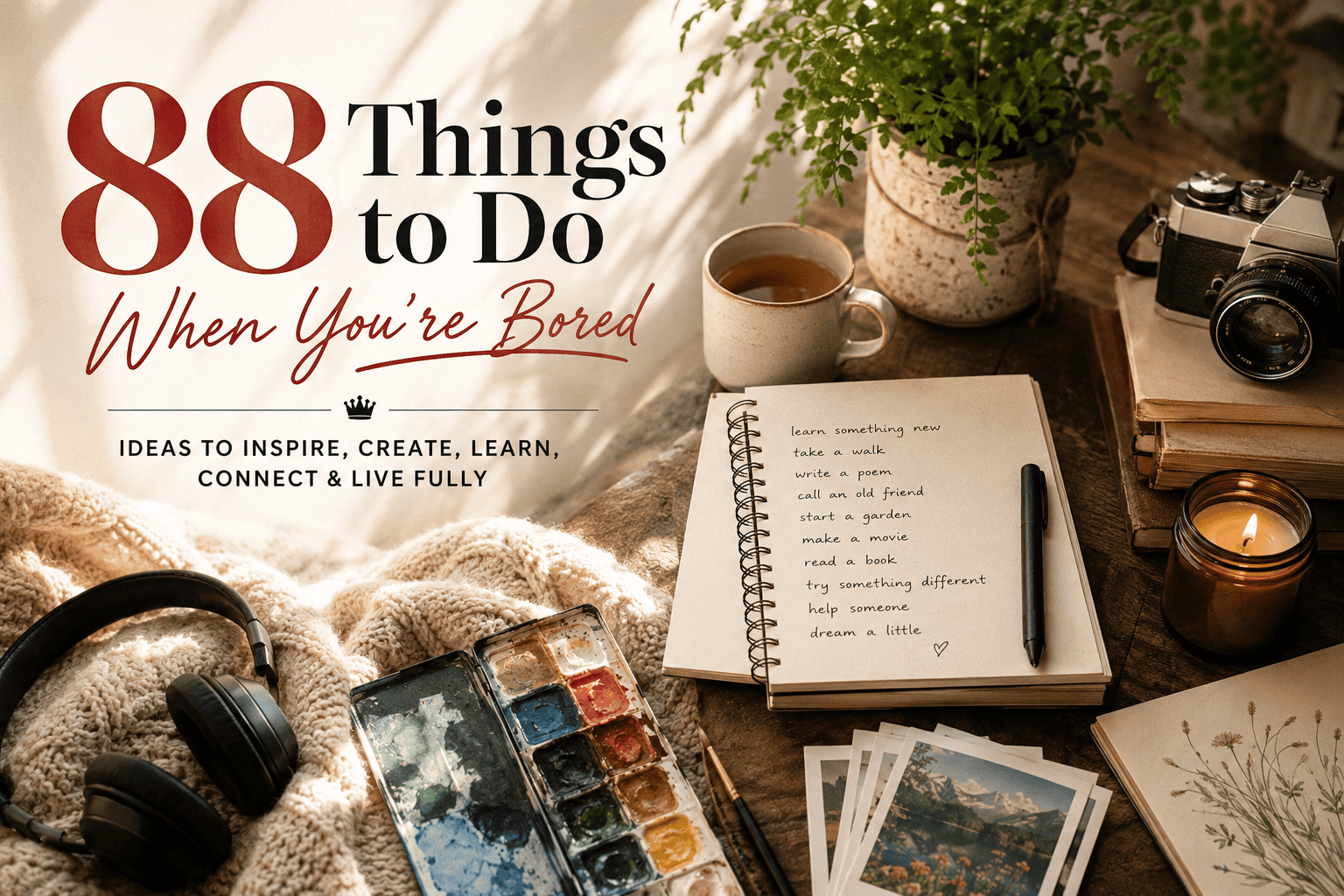
A popular list titled “88 Things to Do When You’re Bored” offers an eclectic collection of activities ranging from taking a walk to learning a new language. At first glance, it appears to be a random assortment of suggestions. But look closer, and something fascinating emerges.
The list is really a map.
A map back to yourself.
Why Boredom Matters More Than We Think
For centuries, some of humanity’s greatest ideas emerged during periods of boredom.
Without constant stimulation, the mind begins to wander. It connects unrelated ideas. It remembers forgotten dreams. It asks questions.
Many people spend years chasing productivity while neglecting imagination.
Yet imagination often arrives when there is nothing else demanding attention.
This is why a walk can become a breakthrough.
A journal entry can become a revelation.
A random conversation can become a life-changing opportunity.
Boredom creates space.
And space is where meaningful experiences begin.
The Art of Moving Your Body
The first category on the list focuses on movement.
Walking.
Going to the gym.
Doing sit-ups.
Stretching.
Practicing yoga.
Dancing.
Joining a sports team.
At first, these seem like simple ways to pass time.
But movement is about much more than exercise.
Luxury hotels invest millions in wellness spaces because physical movement changes how we experience the world. Energy influences perception.
A twenty-minute walk can completely alter your mood.
Stretching can relieve tension you didn’t realize you were carrying.
Dancing can reconnect you with a sense of playfulness that adulthood often suppresses.
Movement reminds us that we are not merely minds attached to screens.
We are physical beings designed to move through the world.
Create Instead of Consume
One of the most interesting themes throughout the list is creation.
Make something.
Write a poem.
Color.
Paint.
Start a garden.
Make a movie.
Put together a time capsule.
Write in your journal.
Create a vision board.
The internet encourages consumption.
Creation demands participation.
There is a profound difference between watching someone else’s creativity and exercising your own.
The quality of the final result is irrelevant.
The painting doesn’t need to belong in a gallery.
The poem doesn’t need to win awards.
The garden doesn’t need to be perfect.
The value exists in the act itself.
Creation transforms boredom into engagement.
It shifts us from passive observers into active participants.
And that transformation is one of life’s most underrated pleasures.
Rediscover the Luxury of Learning
Several suggestions focus entirely on education and curiosity.
Read a book.
Learn something new.
Research places to volunteer.
Study a map of your neighborhood.
Learn a new language.
Read up on current events.
Learn how to tie a necktie and bow tie.
Research rescue animals.
Learn about wine.
Teach yourself the army alphabet.
Many people associate learning with school.
That is unfortunate.
True learning is one of the most luxurious experiences available.
It requires no deadline.
No examination.
No pressure.
Only curiosity.
The most interesting people in the world never stop learning.
They become fascinated by architecture, history, food, language, psychology, fashion, music, travel, and culture.
Knowledge expands the world.
A person who knows little sees little.
A curious person discovers stories everywhere.
Reconnecting With People
One of the strongest themes in the list involves relationships.
Call an old friend.
Send a handwritten note to your grandparents.
Write an email to someone you admire.
Reconnect with a friend in another city.
Ask a friend for a new band recommendation.
Offer help to a friend in need.
Write love notes.
Modern communication has become faster but often less meaningful.
Messages disappear.
Notifications are ignored.
Conversations become fragmented.
A handwritten note, however, feels different.
A phone call feels different.
An unexpected message to someone you haven’t spoken with in years feels different.
Human connection remains one of the most valuable experiences available.
And unlike social media engagement, genuine connection leaves us feeling fuller rather than emptier.
Organize Your Life, Organize Your Mind
Many items on the list focus on organization.
Do your laundry.
Organize something.
Unsubscribe from emails.
Update your résumé.
Make lists.
Create inventories.
Organize apps on your phone.
Clean makeup brushes.
Review photos.
These tasks rarely sound exciting.
Yet they often produce a surprisingly satisfying result.
Clutter creates invisible stress.
A crowded inbox consumes mental energy.
A disorganized phone wastes attention.
A neglected task quietly occupies mental space.
When you complete these small acts of organization, you reclaim control.
Luxury is not merely acquiring more.
Sometimes it is removing what no longer serves you.
The Forgotten Joy of Solitude
Today’s culture often treats being alone as something negative.
Yet many suggestions on the list celebrate solitude.
Take a bubble bath.
Meditate.
Listen to music.
Browse old photographs.
Watch the clouds.
Take a nap.
Read.
Journal.
Visit a garden.
Practice yoga.
These activities require no audience.
No likes.
No comments.
No validation.
Just presence.
Solitude allows us to hear our own thoughts.
In a noisy world, that is increasingly rare.
And increasingly valuable.
Small Adventures Matter
One reason people feel bored is that they believe adventure requires extraordinary circumstances.
They imagine luxury travel, expensive experiences, or dramatic life changes.
The list offers a different perspective.
Take a last-minute road trip.
Visit a new restaurant.
Go to a library.
Explore a garden.
Study your neighborhood map.
Research local events.
Adventure often begins with curiosity rather than distance.
Some people travel across continents and learn nothing.
Others explore a single street and discover something remarkable.
The difference is attention.
Luxury travel magazines frequently focus on destinations.
But experienced travelers know the real secret:
The mindset matters more than the location.
The Digital World Isn’t Always the Enemy
Interestingly, the list doesn’t reject technology.
It includes activities such as:
Watching music videos.
Reading current events.
Downloading apps.
Looking up restaurant reviews.
Browsing online inspiration.
Researching volunteer opportunities.
Watching television.
Technology itself is neutral.
The challenge is intentionality.
Mindless scrolling tends to increase boredom.
Purposeful exploration often reduces it.
The difference lies in whether technology serves your curiosity or merely occupies your attention.
One enriches.
The other distracts.
Pursuing Better Health
Several suggestions focus directly on well-being.
Meditation.
Exercise.
Yoga.
Stretching.
Naps.
Healthy movement.
Learning massage techniques.
These activities remind us that wellness is not a luxury reserved for spa retreats and expensive wellness resorts.
It is built through small daily choices.
A ten-minute stretch.
A short walk.
An earlier bedtime.
A moment of stillness.
These habits rarely generate excitement.
But over time, they transform the quality of life.
The most sustainable luxury is good health.
Without it, everything else loses value.
The Surprising Importance of Play
Many adults gradually abandon play.
Children understand instinctively how to play.
Adults often need permission.
The list quietly provides that permission.
Color.
Dance.
Play games.
Watch animal videos.
Think about Halloween costumes.
Make a movie.
Paint.
Create a vision board.
These activities may seem trivial.
They are not.
Play encourages experimentation.
It reduces stress.
It improves creativity.
It makes life feel lighter.
Some of the most successful people in the world intentionally preserve a sense of playfulness because they understand that innovation often emerges from curiosity rather than seriousness.
Boredom as a Financial Opportunity
The final suggestion on the list is perhaps the most practical:
Figure out a way to make more money.
This is a powerful reminder that boredom can become productive.
Many businesses began because someone had spare time and curiosity.
A blog.
A newsletter.
A YouTube channel.
A freelance service.
An online store.
A consulting practice.
An investment strategy.
An educational platform.
Idle time has often been the birthplace of ambitious ideas.
Instead of asking, “How can I kill time?”
Perhaps a better question is:
“What can I build with this time?”
For entrepreneurs, creators, and dreamers, boredom can become a competitive advantage.
What the 88 Activities Really Teach Us
At first glance, the list appears random.
Walking sits next to painting.
Laundry sits next to meditation.
Restaurant reviews sit next to learning a language.
Yet beneath the surface, a pattern emerges.
The activities encourage five essential things:
- Move your body.
- Engage your mind.
- Create something.
- Connect with others.
- Explore the world around you.
Those five principles have remained timeless despite changes in technology, culture, and society.
People often believe they need more excitement.
What they frequently need instead is more engagement.
The difference is significant.
Excitement is temporary.
Engagement creates meaning.
The Scarlet Kingdom Perspective
True luxury is not the absence of boredom.
It is having the freedom to choose what to do with it.
The person who can spend an afternoon reading in a quiet library, wandering through a garden, writing in a journal, learning a new skill, or reconnecting with an old friend possesses a form of wealth that cannot be measured by income alone.
The list of 88 activities is ultimately not about boredom.
It is about attention.
It is about reclaiming ownership of your time.
It is about discovering that extraordinary experiences often hide inside ordinary moments.
The next time boredom arrives, resist the urge to eliminate it immediately.
Do not reach automatically for another scroll, another video, another distraction.
Instead, treat boredom as a doorway.
Take a walk.
Write a note.
Learn something strange.
Start something new.
Call someone you miss.
Create something imperfect.
Because sometimes the most luxurious thing you can do is simply allow yourself the freedom to be curious.
And curiosity, more than almost anything else, has the power to transform an ordinary afternoon into a memorable one.