
More Than Alcohol, Less Than Business, and Entirely Korean
The first thing most foreigners notice about South Korea’s drinking culture is the amount of alcohol.
The second thing they notice is that nobody seems to be drinking merely for the alcohol.
A typical evening in Seoul begins innocently enough.
The workday ends. Laptops close. Ties loosen. Someone casually asks:
“Would you like to join us for dinner?”
Technically, it is an invitation.
In reality, it is often something closer to a cultural ritual.
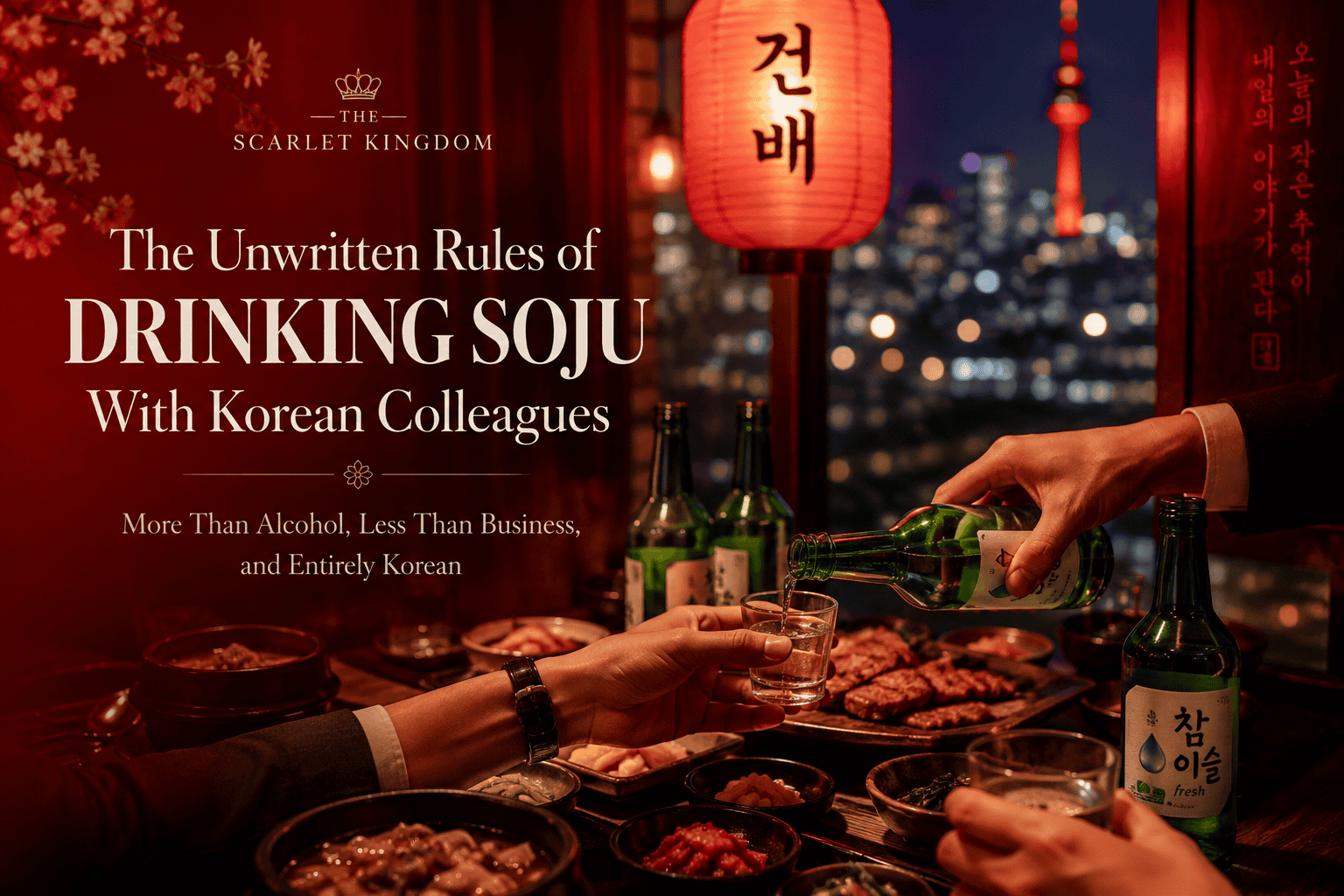
Within an hour, a group of colleagues may be gathered around a grill covered in sizzling pork belly. Steam rises from bubbling stews. Metal chopsticks clink against plates. Green bottles of soju begin appearing on the table.
Conversations that seemed impossible inside the office suddenly become natural.
People laugh louder.
Managers become more approachable.
Junior employees become more confident.
The atmosphere changes.
To outsiders, it can feel like a simple after-work gathering.
To Koreans, however, these evenings are woven deeply into the social fabric of professional life.
And hidden beneath every toast, every poured glass, and every shared bottle are dozens of unwritten rules.
Rules rarely explained.
Rules everyone somehow understands.
Rules that reveal far more about Korean culture than the alcohol itself.
Why Drinking Matters So Much
To understand Korean drinking culture, one must first understand Korean society.
South Korea is one of the most connected and community-oriented societies in the world.
Relationships matter.
Groups matter.
Harmony matters.
For centuries, Korean culture has emphasized collective identity over individual expression.
Family.
School.
Workplace.
Friend groups.
The individual often exists within a larger social structure.
This does not mean Koreans lack individuality.
Rather, relationships frequently take priority over personal preferences.
Drinking culture reflects this philosophy perfectly.
When Korean colleagues drink together, they are not simply consuming alcohol.
They are strengthening social bonds.
The dinner table becomes a place where hierarchy softens and relationships deepen.
In many ways, the meal is often more important than the alcohol.
The alcohol simply helps create the atmosphere.
Rule #1: Never Pour Your Own Drink
This is perhaps the most famous rule.
And also one of the first things foreigners learn.
In many countries, pouring your own drink is perfectly normal.
In Korea, doing so can appear surprisingly awkward.
Instead, people pour drinks for each other.
A colleague notices your glass is empty.
They reach for the bottle.
You notice someone else’s glass is nearly finished.
You do the same.
The gesture may seem small.
Yet it symbolizes attentiveness.
It says:
“I am paying attention to you.”
“I am part of this group.”
“We are sharing this experience together.”
The act transforms drinking from an individual activity into a communal one.
A simple bottle of soju becomes a social tool.
Rule #2: Use Both Hands
If a senior colleague pours you a drink, receiving it with one hand may appear careless.
Instead, tradition encourages using both hands.
One hand holds the glass.
The other supports the wrist or forearm.
The gesture communicates respect.
The same principle often applies when pouring drinks for someone older or higher in rank.
For many younger Koreans, these customs have become less strict than they once were.
Yet they remain widely recognized.
Especially in professional settings.
And while nobody may openly criticize a foreign visitor for forgetting them, understanding these details often earns appreciation.
Rule #3: Age Matters
Age occupies a unique place within Korean culture.
One of the first questions Koreans often ask when meeting someone new is:
“How old are you?”
To outsiders, this can seem surprisingly direct.
But age helps establish social relationships.
It influences language, etiquette, and expectations.
At a dinner table, older individuals frequently receive subtle forms of respect.
The oldest person may begin eating first.
They may receive drinks first.
Others may wait for them to initiate a toast.
Again, these customs are evolving.
Modern Seoul is vastly different from Korea decades ago.
Yet age continues to shape social interactions in ways many visitors find fascinating.
Rule #4: Wait Before Drinking
Imagine a fresh bottle of soju has just arrived.
Glasses are filled.
Everyone is ready.
Yet nobody drinks.
Why?
Because someone important has not raised their glass yet.
Often, the first sip comes after a collective toast.
The senior person may initiate it.
A team leader may offer a few words.
Someone may simply say:
“Geonbae!”
The Korean equivalent of “Cheers.”
Only then do people drink.
The moment creates unity.
Everyone participates together.
Nobody is left out.
Nobody begins early.
The group moves as one.
Rule #5: Food Is Not Optional
One of the biggest misunderstandings foreigners have about Korean drinking culture is assuming the alcohol is the main attraction.
It is not.
Food is everywhere.
And often in enormous quantities.
Grilled meat.
Seafood pancakes.
Spicy stews.
Fried chicken.
Rice dishes.
Late-night noodles.
The evening typically unfolds through multiple rounds.
A barbecue restaurant may become a cocktail bar.
The cocktail bar may become a late-night snack spot.
The snack spot may become a karaoke room.
Food remains a constant companion.
In Korea, drinking rarely exists in isolation.
It is part of a larger social experience.
Rule #6: The First Round Is About Work
Something interesting happens during Korean company dinners.
The first hour often resembles an extension of the workplace.
People discuss projects.
Goals.
Clients.
Challenges.
Professional topics dominate the conversation.
Then gradually something changes.
The atmosphere softens.
Laughter increases.
Stories emerge.
Personal conversations begin.
By the second or third venue, discussions may have little to do with work at all.
This transformation is one reason many Korean companies value these gatherings.
They create connections difficult to build during office hours.
Rule #7: Karaoke Is Not About Singing Well
At some point during the evening, someone inevitably suggests karaoke.
In Korea, this usually means visiting a noraebang, literally translated as “singing room.”
For many visitors, the idea sounds intimidating.
Especially those convinced they cannot sing.
Fortunately, singing talent is almost irrelevant.
A noraebang is not a performance.
It is participation.
The goal is enthusiasm.
Not perfection.
The quiet accountant becomes a rock star.
The serious manager suddenly sings 1990s ballads.
Everyone cheers.
Everyone laughs.
Embarrassment disappears remarkably quickly.
And that is precisely the point.
Rule #8: Declining Alcohol Is Becoming More Acceptable
One of the biggest changes in modern Korean drinking culture is flexibility.
Older generations often describe workplace drinking as almost mandatory.
You drank because everyone drank.
Today, things are changing.
Younger professionals increasingly prioritize health and personal choice.
Many choose non-alcoholic alternatives.
Others drink less.
Companies are gradually adapting.
The expectation of participation remains.
But participation no longer always requires alcohol.
What matters most is often presence rather than consumption.
Showing up.
Sharing the meal.
Being part of the group.
The Hidden Purpose Behind It All
To outsiders, Korean drinking culture can seem complicated.
There are rules.
Hierarchies.
Traditions.
Customs.
But beneath all of them lies something surprisingly simple.
Connection.
The purpose is not intoxication.
The purpose is belonging.
A shared meal.
A shared bottle.
A shared evening.
These moments create relationships.
And relationships remain one of the most important currencies in Korean society.
In an increasingly digital world, where many interactions occur through screens, Korean drinking culture preserves something profoundly human.
People gather around a table.
They eat.
They talk.
They laugh.
They stay longer than planned.
And gradually strangers become colleagues.
Colleagues become friends.
Friends become part of one another’s lives.
A Night in Seoul
Walk through Seoul after midnight and you will see countless versions of this story unfolding simultaneously.
Office workers sharing grilled pork beneath glowing signs.
Friends gathered around outdoor tables.
Students laughing over convenience-store drinks beside the Han River.
Couples sharing late-night meals.
The city feels alive.
Not because people are drinking.
But because people are together.
That is the real story hidden inside Korea’s famous soju culture.
Not alcohol.
Not business.
Not tradition alone.
But the simple belief is that life’s most meaningful conversations often happen after the official day has ended.
And perhaps that is why Seoul never truly sleeps.
Because somewhere, beneath neon lights and rising steam, another conversation is just beginning.