
Why everything you do matters more than you think.
The word karma has become one of the most misunderstood concepts in modern culture.
People often use it casually.
Someone cuts in line and later spills coffee on themselves.
“Karma.”
A dishonest person faces consequences.
“Karma.”
An arrogant celebrity experiences a public downfall.
“Karma.”
While these examples may seem satisfying, they barely scratch the surface of what karma actually represents.
In its deeper philosophical sense, karma is not a cosmic punishment system waiting to reward good people and punish bad ones. It is a framework for understanding how actions, intentions, choices, and behaviors shape the reality we experience.
Karma is about cause and effect.
Every action creates a consequence.
Every decision creates a direction.
Every habit creates a future.
The concept has roots in ancient Eastern traditions, but its lessons remain remarkably relevant in today’s world. Whether you’re building a career, creating relationships, pursuing success, or searching for meaning, the principles behind karma offer timeless guidance.
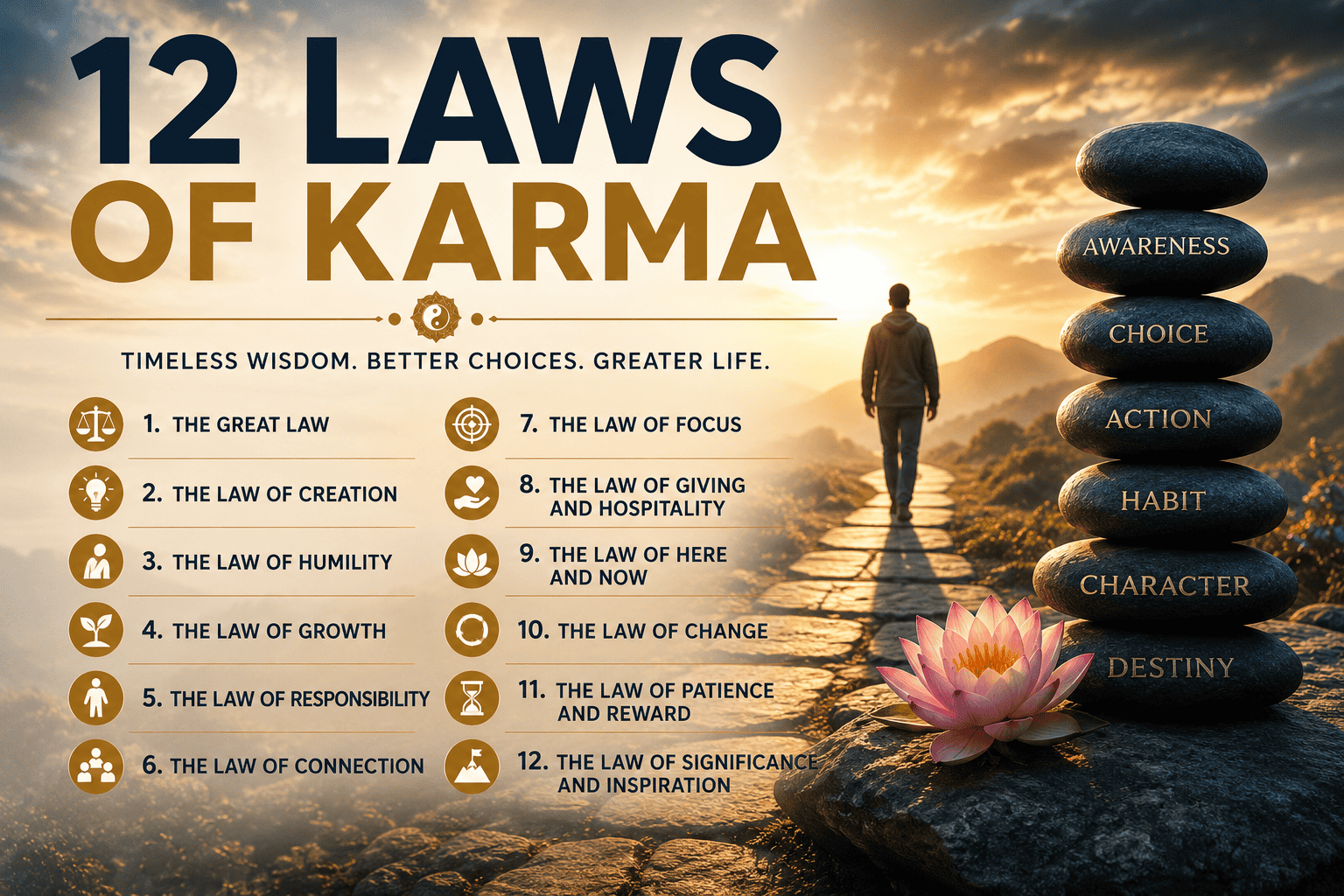
Among the many interpretations of karma, one of the most widely shared frameworks is the 12 Laws of Karma. These laws provide a practical philosophy for living with greater awareness, responsibility, and purpose.
Rather than mystical rules imposed from above, they are observations about how life tends to unfold.
Let’s explore each one and discover why they continue to resonate across generations.
1. The Great Law
“Whatever we put into the universe will come back to us.”
This is the foundation upon which all the other laws rest.
The Great Law is often summarized in a simple phrase:
You reap what you sow.
Every action creates a ripple.
Every word affects someone.
Every choice influences future outcomes.
This doesn’t mean life operates like a perfect mathematical equation where every good deed instantly produces a reward.
Reality is far more complex.
However, over time, patterns emerge.
People who consistently act with integrity tend to build trust.
People who consistently show kindness tend to create stronger relationships.
People who consistently pursue excellence tend to develop valuable skills.
Likewise, dishonesty, resentment, laziness, and cruelty often generate consequences that eventually return to the source.
The Great Law reminds us that we are constantly planting seeds.
The future is often the harvest of today’s actions.
2. The Law of Creation
“Life does not happen by itself. We need to make it happen.”
Many people spend years waiting.
Waiting for an opportunity.
Waiting for motivation.
Waiting for the perfect time.
Waiting for someone else to change their lives.
The Law of Creation suggests a different approach.
Life is not merely something that happens to us.
It is something we actively participate in creating.
The career you want requires action.
The relationship you desire requires effort.
The skills you admire require practice.
The future you imagine requires contribution.
Luxury, success, happiness, fulfillment—none arrive automatically.
They are built.
This law encourages personal agency.
Instead of asking:
“Why isn’t my life changing?”
Ask:
“What am I creating today?”
The answer often reveals the future.
3. The Law of Humility
“One must accept something in order to change it.”
This may be one of the most difficult laws to practice.
Human beings naturally resist uncomfortable truths.
We defend our mistakes.
We deny our weaknesses.
We blame circumstances.
We blame other people.
Yet transformation begins with honesty.
You cannot improve a problem you refuse to acknowledge.
You cannot heal a wound you pretend doesn’t exist.
You cannot overcome a weakness you refuse to recognize.
Humility is not self-criticism.
It is self-awareness.
It means seeing reality clearly, without distortion.
The strongest leaders, creators, and thinkers possess this quality.
They are willing to admit when they are wrong.
They are willing to learn.
They are willing to evolve.
The moment we stop pretending is often the moment growth begins.
4. The Law of Growth
“When we change ourselves, our lives change too.”
Many people devote enormous energy to trying to change external circumstances.
They want different jobs.
Different cities.
Different friends.
Different opportunities.
Yet the Law of Growth suggests that meaningful transformation begins internally.
The world often reflects who we become.
Develop better communication skills, and relationships improve.
Develop discipline, and productivity improves.
Develop confidence, and opportunities appear differently.
Develop wisdom, and challenges become easier to navigate.
Growth is not always visible.
It happens gradually.
Quietly.
Day by day.
But over time, internal change creates external results.
The most powerful investment you can make is often in your own development.
5. The Law of Responsibility
“We must take responsibility for what is in our lives.”
Responsibility can feel heavy.
Yet it is also empowering.
When we blame everything on circumstances, luck, society, or other people, we surrender control.
Responsibility restores it.
This law does not suggest that every event is our fault.
Life contains randomness.
Unexpected hardships happen.
Injustice exists.
Circumstances vary dramatically.
However, regardless of what happens, we remain responsible for our response.
We choose our attitude.
We choose our actions.
We choose what we do next.
The moment we embrace responsibility, we stop being passive observers and become active participants.
Responsibility is not punishment.
It is power.
6. The Law of Connection
“The past, present, and future are all connected.”
Nothing exists in isolation.
Today’s circumstances are linked to yesterday’s decisions.
Tomorrow’s opportunities are influenced by today’s actions.
Every chapter of life is connected.
This law encourages long-term thinking.
The workout you complete today may improve your health years from now.
The book you read today may influence a future career decision.
The person you meet today may become a lifelong friend.
The habit you develop today may shape your future identity.
Modern culture often prioritizes immediate gratification.
The Law of Connection reminds us that every moment participates in a larger story.
The future is not separate from the present.
It grows from it.
7. The Law of Focus
“We cannot think of two different things at the same time.”
Attention is one of the most valuable resources in modern life.
Yet it is constantly under attack.
Notifications.
Messages.
Advertisements.
Endless content.
The Law of Focus highlights a simple truth:
Where attention goes, energy follows.
A scattered mind produces scattered results.
A focused mind produces progress.
The world’s greatest achievements rarely emerge from divided attention.
They emerge from concentration.
A writer focuses on writing.
An athlete focuses on training.
An artist focuses on creating.
A leader focuses on priorities.
This law does not merely apply to productivity.
It also applies emotionally.
Gratitude and resentment struggle to occupy the same space.
Purpose and distraction compete constantly.
The quality of life is often determined by the quality of focus.
8. The Law of Giving and Hospitality
“Our behavior should match our thoughts and actions.”
Authenticity is increasingly rare.
Many people say one thing and do another.
They promote values they don’t practice.
They advocate principles they don’t follow.
The Law of Giving and Hospitality challenges this inconsistency.
It encourages alignment.
If kindness matters, demonstrate kindness.
If honesty matters, practice honesty.
If generosity matters, be generous.
Character is not defined by intentions alone.
It is revealed through behavior.
The most respected individuals are often those whose actions consistently match their beliefs.
Their lives feel coherent.
Trustworthy.
Authentic.
In a world full of performance, authenticity becomes a form of quiet luxury.
9. The Law of Here and Now
“We cannot be present if we are looking backward.”
Many people live in the past.
They replay mistakes.
Relive regrets.
Revisit disappointments.
Others live exclusively in the future.
They constantly worry about outcomes that haven’t happened.
The Law of Here and Now reminds us that life only exists in one place:
The present moment.
The past cannot be changed.
The future cannot be controlled.
Only the present can be experienced.
This doesn’t mean ignoring lessons from the past or neglecting future planning.
It means avoiding captivity.
A person trapped by yesterday cannot fully experience today.
Presence is increasingly difficult in an age of constant distraction.
Yet it remains one of the most valuable human skills.
The richest moments of life happen now.
Not yesterday.
Not tomorrow.
Now.
10. The Law of Change
“History repeats itself until we learn from it and change our path.”
Patterns exist everywhere.
In relationships.
In careers.
In finances.
In personal habits.
Many people find themselves facing the same challenges repeatedly.
Different circumstances.
Different people.
Same outcome.
The Law of Change asks a powerful question:
What lesson am I refusing to learn?
Until awareness emerges, patterns tend to repeat.
The same mistakes.
The same arguments.
The same fears.
The same self-sabotage.
Growth requires interruption.
The cycle only breaks when understanding appears.
Wisdom is not merely accumulating experiences.
It is learning from them.
11. The Law of Patience and Reward
“The most valuable rewards require persistence.”
Modern culture celebrates speed.
Instant deliveries.
Instant entertainment.
Instant communication.
Instant gratification.
Yet most meaningful achievements require patience.
A great business takes years to build.
Mastery requires thousands of hours.
Strong relationships develop over time.
Trust is earned slowly.
Personal growth unfolds gradually.
The Law of Patience and Reward teaches that worthwhile outcomes rarely happen overnight.
Seeds require time.
Skills require repetition.
Dreams require persistence.
The ability to remain committed during periods of slow progress often separates success from failure.
Patience is not passive waiting.
It is a consistent effort combined with trust in the process.
12. The Law of Significance and Inspiration
“Rewards are a result of the energy and effort we put into it.”
The final law brings all the others together.
Life often reflects contribution.
The value we create influences the results we receive.
This principle appears everywhere.
Artists who dedicate themselves to their craft produce meaningful work.
Entrepreneurs who solve genuine problems create successful businesses.
Teachers who invest deeply in students leave lasting impacts.
Leaders who serve others inspire loyalty.
The Law of Significance and Inspiration reminds us that effort matters.
Energy matters.
Commitment matters.
Not all effort produces immediate results.
Not every contribution receives recognition.
But meaningful work leaves a mark.
Every person possesses the capacity to influence the world around them.
The question is not whether our actions matter.
The question is how we choose to use them.
The Hidden Thread Connecting All 12 Laws
When viewed together, these laws reveal a profound message.
They are not really about fate.
They are about participation.
They teach that life is not merely something that happens to us.
It is something we help create.
The Great Law teaches consequence.
Creation teaches initiative.
Humility teaches awareness.
Growth teaches transformation.
Responsibility teaches ownership.
Connection teaches perspective.
Focus teaches discipline.
Giving teaches authenticity.
Here and Now teaches presence.
Change teaches learning.
Patience teaches persistence.
Significance teaches contribution.
Together, they form a philosophy centered on intentional living.
The Scarlet Kingdom Perspective
In luxury culture, people often focus on visible symbols of success.
The watch.
The car.
The home.
The destination.
Yet beneath every enduring success story lies something less visible.
Character.
Discipline.
Responsibility.
Patience.
Growth.
Focus.
The 12 Laws of Karma are ultimately not about mystical rewards or punishments.
They are about understanding the relationship between actions and outcomes.
They remind us that every day we are shaping the person we become.
Every conversation matters.
Every habit matters.
Every decision matters.
Every action contributes to a larger story.
Whether one views karma as spiritual truth, philosophical wisdom, or practical psychology, its central lesson remains timeless:
The life you experience tomorrow is being created by the choices you make today.
And perhaps that is the most powerful law of all.