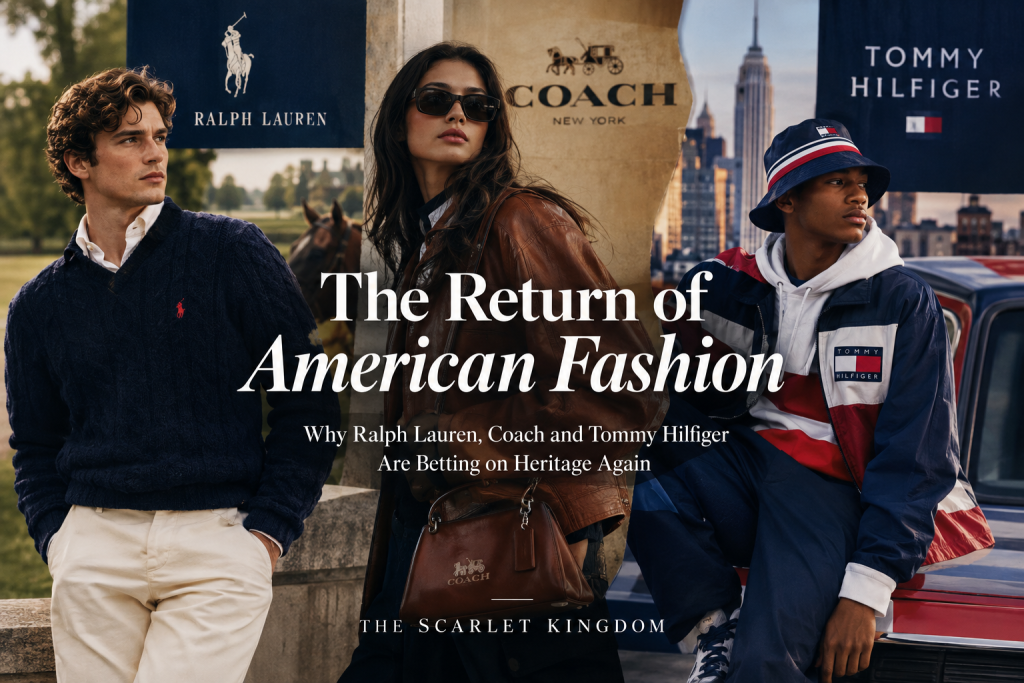
There is something interesting happening in American fashion right now.
It is not particularly loud. There is no single silhouette responsible for it, no one designer who can claim to have started it, and certainly no single collection that explains everything. Instead, it is appearing in fragments: a familiar polo shirt suddenly looking expensive again, an old Coach handbag becoming desirable to a generation that was barely old enough to remember the brand’s earlier years, a Tommy Hilfiger rugby returning in a new proportion, or a runway filled with the kind of American clothes that once seemed too ordinary to be called luxury.
The strange part is that none of this is particularly new.
That is precisely the point.
Ralph Lauren, Coach and Tommy Hilfiger are among the clearest examples of American fashion companies discovering that their past is not necessarily baggage. It can be an asset.
Ralph Lauren has spent decades building an entire fantasy around American life — from polo fields and country houses to New York tailoring, denim, Western references and relaxed sportswear. Coach has taken the language of American leather goods and transformed it into something considerably more youthful, fashion-conscious and digitally fluent. Tommy Hilfiger, meanwhile, is once again leaning into the prep, sport, music and New York codes that helped define its original cultural identity.
And the commercial evidence is becoming difficult to ignore.
Ralph Lauren reported that fiscal 2026 revenue increased 15% on a reported basis, while its first quarter of fiscal 2027 brought another 14% increase in reported revenue, with particularly strong direct-to-consumer performance. Coach’s parent company Tapestry reported $6.9 billion in Coach revenue for fiscal 2026, up 24% year over year. Tommy Hilfiger, meanwhile, continues to build its global business around what PVH calls its “Classic American Cool” identity, with global retail sales of Tommy Hilfiger products reaching approximately $9 billion in 2024.
This is more than nostalgia.
It is a business strategy.
And perhaps the most fascinating thing about it is that the brands are not really selling the past. They are trying to make the past useful again.
What happened to American fashion?
For much of the second half of the twentieth century, American fashion represented modernity in a way that was fundamentally different from European luxury.
Paris had couture.
Milan had tailoring and leather craftsmanship.
London had its eccentricity and rebellious tailoring.
America had sportswear.
That sounds simple, but it was extraordinarily influential.
The American fashion system turned ordinary clothing categories into cultural statements: denim, T-shirts, sweatshirts, polo shirts, varsity jackets, sneakers, leather jackets, chinos, baseball caps, workwear and relaxed tailoring.
Hollywood made American clothing aspirational. Music made it rebellious. Universities made it preppy. Athletes made it physical. New York made it cosmopolitan.
American fashion did not need centuries-old aristocratic associations to become influential. It had popular culture.
That distinction remains important.
Ralph Lauren’s universe, for example, is filled with elements that are recognizably American: the polo player, the Oxford shirt, the cable-knit sweater, the riding boot, the tailored blazer, denim, Western shirts and country-club references. Yet Lauren elevated those things through extraordinary consistency and world-building.
Tommy Hilfiger did something different. He connected American sportswear to music, celebrity culture, MTV and youth culture, turning red, white and blue branding into something that could be worn by both suburban preppies and hip-hop stars.
Coach began with another quintessentially American idea: practical leather goods.
But fashion changed.
The 2000s and 2010s rewarded novelty. Streetwear became increasingly influential. Luxury houses embraced collaborations. Logos became cultural currency. Social media accelerated trend cycles. A product could become famous globally within hours and disappear just as quickly.
American brands had to compete in this environment while carrying identities that were sometimes decades old.
That created an uncomfortable question:
What happens when a brand’s greatest strength — its history — begins to look like its greatest weakness?
The answer emerging in 2026 is surprisingly optimistic.
You modernize the history.
Heritage is not the same thing as being old
There is an important distinction between an old brand and a heritage brand.
An old brand simply has history.
A heritage brand knows how to use its history.
That difference matters.
A company can have fifty years of archives and still feel completely irrelevant. Another company can take one recognizable silhouette from twenty years ago and make it feel irresistible to a customer who was not even alive when it first appeared.
The archive is therefore not the product.
The archive is the source material.
This is particularly valuable at a time when consumers are surrounded by endless novelty.
There are new labels every week. New collaborations every month. New microtrends every few days.
Eventually, novelty begins to lose its power.
Recognition starts to matter again.
A familiar shape tells a consumer something immediately. A particular Coach bag has a history. A Ralph Lauren polo has a visual vocabulary. A Tommy Hilfiger rugby shirt carries decades of associations with American prep, sport and popular culture.
The consumer does not have to understand every detail of that history.
They simply have to feel it.
That is where heritage becomes commercially interesting.
It provides context before the customer has even purchased the product.
And younger consumers are discovering this history in completely different ways from previous generations.
They are not necessarily reading brand histories in books or watching television advertisements.
They are encountering old fashion through TikTok, Instagram, Pinterest, resale platforms, vintage stores, celebrity wardrobes and algorithmically resurrected photographs.
A teenager can discover a 1990s Tommy Hilfiger campaign without having any personal memory of the 1990s.
Someone can find a vintage Coach bag online and fall in love with it before learning that Coach has been making leather goods since 1941.
A young consumer can encounter Ralph Lauren not as the brand their parents wore, but as a visual language that suddenly looks remarkably contemporary.
That changes everything.
Ralph Lauren: selling an American dream that never really went away
Ralph Lauren is probably the clearest example of American heritage functioning as a luxury business model.
The brand is not simply selling shirts.
It is selling a world.
That world includes Manhattan apartments, country estates, polo fields, old cars, denim, tailoring, Western clothing, equestrian references, sportswear and a particular idea of effortless American confidence.
It is one of fashion’s most successful examples of lifestyle construction.
The extraordinary thing is that the fantasy has remained recognizable for decades.
Ralph Lauren Corporation describes itself as a global leader across apparel, footwear and accessories, home, fragrances and hospitality, with a family of brands that includes Ralph Lauren Collection, Purple Label, Double RL, Polo Ralph Lauren and others.
That breadth matters because it means the heritage story does not end with a polo shirt.
The brand can occupy an entire lifestyle.
A consumer might encounter Ralph Lauren through a shirt, a fragrance, a restaurant, a home collection or a hotel experience. Each reinforces the others.
The fashion becomes more convincing because the world surrounding it is so carefully constructed.
And 2026 has offered some fascinating evidence that the company is not afraid to revisit its own vocabulary.
For Fall 2026, Polo Ralph Lauren drew directly on Ralph Lauren’s early years and the 1970s New York period, while combining familiar Polo language with a fresh presentation format.
Ralph Lauren’s Fall 2026 collection similarly brought together rugged Americana, tailoring, country-house imagery and highly crafted materials. Vogue noted how the collection blended indoor and outdoor clothing, formal and casual dressing, and rugged and refined elements — a combination that has become almost synonymous with the Ralph Lauren vocabulary.
This is the important distinction.
Ralph Lauren does not appear to be asking:
“How can we make old Ralph Lauren clothes again?”
It is asking something more sophisticated:
“How can the Ralph Lauren world remain desirable now?”
That is why consistency becomes an advantage rather than a limitation.
Fashion often rewards reinvention.
Ralph Lauren has spent decades proving that recognition can be equally powerful.
Its first-quarter fiscal 2027 results reinforce the commercial argument. Revenue increased 14% year over year on a reported basis, while global direct-to-consumer comparable-store sales grew at a low-double-digit rate and average unit retail increased 15%.
That does not prove that heritage alone caused the growth.
It does, however, demonstrate that a recognizable American luxury identity can remain commercially powerful.
There is another subtle advantage.
Ralph Lauren’s American dream is not necessarily America’s literal reality.
It is an edited version.
It is America as imagined through clothes, interiors, landscapes, leisure and aspiration.
And perhaps that is why it has traveled so successfully around the world.
A consumer in Mumbai, Seoul, Paris or London does not have to be American to understand the fantasy.
They simply have to recognize what it represents.
Coach: when heritage becomes young again
Coach tells a different story.
Where Ralph Lauren has built an enormous lifestyle universe, Coach has found extraordinary power in specific objects — especially handbags.
The brand’s transformation is one of the more interesting American fashion stories of the past decade because it demonstrates that heritage does not have to make a brand conservative.
It can make it culturally recognizable.
Coach was founded in New York in 1941 and built its reputation around leather goods. Its history therefore contains something unusually useful for modern luxury: physical craftsmanship.
Leather ages.
Leather develops character.
A leather bag can become more interesting through use.
That gives heritage a tactile dimension.
Under Stuart Vevers, Coach increasingly connected that history with contemporary fashion and youth culture. The result has been a brand that can reference its archives without looking trapped inside them.
The Fall 2026 collection is revealing.
Vevers’s references included young Jodie Foster, a California skateboarder, 1970s flares and The Wizard of Oz. Rather than treating “American” as one narrow aesthetic, the collection expanded its interpretation toward a broader idea of the United States.
That is smart.
America is not one look.
It is a collection of contradictions.
Hollywood and skateboarding.
New York and California.
Workwear and glamour.
Luxury and mass culture.
Youth rebellion and traditional craftsmanship.
Coach has become particularly good at turning those contradictions into product.
The commercial performance is significant.
Tapestry reported that Coach generated approximately $6.9 billion in fiscal 2026 revenue, representing 24% reported growth from the previous year.
Earlier in fiscal 2026, Tapestry also reported that more than 35% of its new customers were Gen Z, while Coach handbag units increased by more than 20% and average unit retail rose at a low-double-digit rate.
The company’s own materials have highlighted Coach Originals, a collection featuring archival bags with a modern sensibility, as an important contributor to growth among Gen Z consumers.
That is the heritage equation in miniature.
Take the archive.
Keep enough of it to create recognition.
Change enough of it to create desire.
The Tabby is perhaps the clearest example. It has become a recognizable contemporary Coach shape while sitting comfortably within a broader conversation about archival American fashion.
And then Coach adds the things modern consumers respond to: charms, customization, new materials, new colors, social storytelling and celebrity visibility.
The brand is not asking a young consumer to appreciate Coach because it has existed since 1941.
It is giving that consumer a product they already want and then allowing the history to make the product more meaningful.
That is a much stronger proposition.
Tommy Hilfiger and the return of the 1990s
Tommy Hilfiger’s heritage story may be the most obviously nostalgic of the three.
The brand’s original cultural power was built around an unmistakably American mixture of prep, denim, sportswear, music and celebrity culture.
It was New York.
It was red, white and blue.
It was rugby shirts and jeans.
It was the world of MTV, hip-hop, sport and 1990s youth culture.
But that history also creates a problem.
Nostalgia can be incredibly powerful, but it can become a costume.
The challenge for Tommy Hilfiger is therefore not simply to bring back the 1990s.
It is to make the visual language of the 1990s function in the 2020s.
The brand’s current strategy is increasingly explicit about this.
PVH describes Tommy Hilfiger as a brand rooted in “Classic American Cool,” with a red, white and blue DNA and an approach it calls “Prep made Modern.”
In 2026, that idea has been translated into an unusually wide cultural program.
The brand partnered with Liverpool FC, bringing New York prep into global football culture.
It partnered with the Cadillac Formula 1 team, connecting American sportswear with the global spectacle of motorsport.
It launched a U.S. SailGP Team capsule rooted in archive sailing gear and performance innovation.
It even used Peanuts in a Fall 2026 kids’ collection, connecting modern prep with another enduring piece of American popular culture.
These partnerships are not random.
They demonstrate the structure of the brand’s heritage.
Tommy Hilfiger’s history has always been about the intersection of fashion and culture.
Fashion.
Music.
Entertainment.
Sport.
The company itself emphasizes that connection in its current storytelling.
The upcoming Spring 2027 runway show makes the strategy even more obvious.
For September 10, 2026, Tommy Hilfiger announced a New York Fashion Week presentation at The Plaza Hotel, a setting deeply connected to the designer’s personal history and the mythology of New York.
That is heritage as theatre.
And it is smart because it makes the brand’s history physically visible.
For Fall 2026, the brand continued with “Prep Made Current,” using cable knits, rugby shirts, archival detailing and updated proportions rather than simply reproducing vintage clothing.
Its denim campaign starring Romeo Beckham went even further into the idea of generational transmission. The campaign explicitly connected contemporary denim with 1990s-inspired silhouettes and a younger fashion audience.
The message is clear:
The past belongs to whoever can make it feel current.
The archive has become a business asset
There was a time when fashion archives were mostly useful to historians, designers and collectors.
That is changing.
Today, an archive can function as a marketing department, a product-development library, a social-media content engine and a source of commercial differentiation.
The reason is simple.
Fashion consumers are drowning in information.
A new product has to compete with thousands of other new products.
An archival product arrives with a story already attached.
That story may be imperfect.
It may even be exaggerated by marketing.
But it exists.
This is why heritage can reduce a brand’s need to explain itself from zero every season.
Ralph Lauren does not need to teach the world what a Polo shirt represents.
Coach does not need to invent the idea of American leather craftsmanship.
Tommy Hilfiger does not need to explain why red, white and blue, rugby shirts, denim and prep belong together.
The consumer already understands the symbols.
The creative challenge is to rearrange them.
This is also why archive fashion and resale have become so important to the wider ecosystem.
A vintage garment can introduce a consumer to a brand.
That consumer can then discover the current collection.
In other words, the past can become a customer-acquisition channel for the present.
That is a very different relationship with history.
Why Gen Z is fascinated by brands older than they are
There is a delicious contradiction at the heart of the current fashion cycle.
Young consumers are supposed to want something new.
Instead, many are looking backward.
But perhaps “backward” is the wrong word.
They are looking sideways through time.
A Gen Z consumer does not necessarily experience a 1990s Tommy Hilfiger sweatshirt as nostalgia.
They experience it as discovery.
That distinction matters.
Nostalgia belongs to someone who remembers.
Discovery belongs to someone encountering something for the first time.
Digital culture has effectively turned the twentieth century into a searchable wardrobe.
Pinterest can make 1994 look like yesterday.
TikTok can resurrect a forgotten handbag overnight.
Instagram can turn an old campaign photograph into a mood board.
Resale platforms can place a garment from twenty-five years ago next to a contemporary collection.
The result is that fashion history no longer moves strictly forward.
It moves in every direction.
That creates extraordinary opportunities for heritage brands.
The danger, however, is that heritage can become too dependent on algorithms.
A brand can become fashionable because a particular bag goes viral, only to discover that virality is not the same as loyalty.
Coach appears to be trying to build beyond that moment.
Tapestry’s fiscal 2026 results show that Coach’s growth was broad rather than confined to one isolated product. The company reported strength across handbags and other categories while emphasizing innovation, craftsmanship and new customer acquisition.
That is the healthier version of nostalgia.
Nostalgia attracts attention.
Product quality has to convert that attention into a relationship.
American heritage versus European luxury
The renewed interest in American fashion also raises an interesting question.
What does American luxury actually mean?
European luxury has traditionally been associated with institutions: couture houses, ateliers, aristocratic histories, royal associations, centuries of craftsmanship and particular European cities.
American fashion inherited a different kind of cultural capital.
It inherited Hollywood.
Jazz.
Rock.
Hip-hop.
Baseball.
Basketball.
Universities.
Cars.
Road trips.
Workwear.
Denim.
New York.
California.
The American luxury proposition therefore tends to be less about aristocracy and more about cultural participation.
That may explain why it can feel particularly compatible with younger consumers.
A person does not need to imagine themselves as European royalty to participate in American heritage.
They can wear denim.
They can wear a varsity jacket.
They can carry a leather bag.
They can put on a polo shirt.
They can wear a rugby shirt.
The codes are accessible even when the best versions are expensive.
That is one of American fashion’s greatest strengths.
It can turn ordinary cultural objects into luxury symbols.
Ralph Lauren elevated the polo shirt into a lifestyle.
Coach turned practical leather goods into fashion objects.
Tommy Hilfiger turned prep and sportswear into pop culture.
None of those achievements required American fashion to imitate Paris.
The renewed heritage movement may therefore be less about American brands becoming “more luxurious” and more about them becoming more confident in what American luxury already is.
The business case for nostalgia
There is also a cold commercial logic behind all of this.
Heritage gives brands recognizable intellectual property.
A recognizable logo, silhouette, pattern, product family or design code can be reinterpreted repeatedly.
That does not mean a brand can simply reproduce the same product forever.
It means the consumer already understands the language.
This can help brands build franchises.
Coach’s strategy illustrates this particularly well: established handbag families can be refreshed through new materials, sizes, colors and styling rather than replaced entirely. Tapestry has specifically highlighted the strength of its core icons and their role in attracting younger customers.
Ralph Lauren operates on an even larger scale.
The brand can reinterpret prep, Western clothing, tailoring, sportswear or equestrian references across multiple categories and price points.
Tommy Hilfiger can take prep into football, Formula 1, sailing, denim or New York nightlife.
The archive becomes a creative vocabulary.
But there is a risk.
Heritage can become lazy.
Once a company discovers that consumers like nostalgia, it can become tempting to reproduce old logos, old campaigns and old silhouettes endlessly.
That eventually stops feeling authentic.
It begins to feel like merchandising.
The strongest brands understand the difference.
The goal is not to recreate 1995.
The goal is to understand why 1995 mattered.
That distinction is everything.
The return of American fashion is bigger than three brands
Ralph Lauren, Coach and Tommy Hilfiger are not operating in isolation.
Their strategies exist alongside renewed interest in denim, Western clothing, collegiate fashion, workwear, sportswear and vintage American design.
Even the broader fashion environment is reflecting this appetite.
Vogue’s Fall 2026 accessory coverage highlighted Western-inspired belts among the season’s prominent directions, while the Spring 2027 New York Fashion Week landscape includes a strong interest in vintage, Western and sporty references.
The important thing is that these categories are not merely American because American brands sell them.
They are American because American culture helped turn them into global fashion languages.
This creates an unusual moment.
For decades, American fashion often exported culture without receiving the same prestige traditionally associated with European luxury.
Now, the cultural material that American fashion created is becoming a source of renewed luxury value.
That is a meaningful shift.
Is American fashion really having a comeback?
It would be easy to declare victory too early.
Three successful brands do not automatically prove the return of an entire national fashion industry.
There is a danger in turning every vintage reference into evidence of a cultural revolution.
Fashion loves narratives.
“American fashion is back” is a very good one.
Reality is more complicated.
American consumers may simply be participating in a global nostalgia cycle.
European houses are also mining archives.
Luxury brands everywhere are rediscovering historical silhouettes.
Young shoppers are experimenting with vintage because vintage is accessible, distinctive and increasingly desirable.
So perhaps the real story is not that American fashion is replacing European luxury.
It is that American heritage has become newly valuable within a broader global appetite for recognizable identity.
That is still significant.
The deeper question is whether the trend can survive after nostalgia stops being fashionable.
Coach has perhaps the strongest test here.
Its financial performance suggests that the brand is doing more than simply generating temporary attention. Tapestry reported 24% annual Coach revenue growth in fiscal 2026 and said it had acquired millions of new customers, with Gen Z representing more than a third of new customers during the fiscal third quarter.
Ralph Lauren’s continued revenue growth similarly suggests that its established codes are not preventing contemporary commercial expansion.
Tommy Hilfiger’s current strategy is perhaps still more of a creative proposition to watch, particularly as it uses sport, celebrity, New York and its archive to connect with a new generation. Its 2026 activity shows a deliberate effort to place American prep inside globally relevant cultural environments.
The test will be longevity.
If consumers continue returning to these brands after the current nostalgia wave fades, heritage will have proved itself to be more than a trend.
What happens next?
The future of American heritage fashion probably will not be about choosing between the past and the future.
The successful brands will need both.
Archive plus innovation.
Nostalgia plus modernity.
Craftsmanship plus accessibility.
American identity plus global culture.
Recognition plus reinvention.
Ralph Lauren understands this because its entire business has always been built around evolving a recognizable world.
Coach understands it because its strongest current products can feel both historically connected and completely contemporary.
Tommy Hilfiger is testing it by taking its prep vocabulary into Formula 1, football, sailing, denim, celebrity culture and new generations of consumers.
That is why “heritage” is perhaps not the best word for what is happening.
Heritage sounds static.
What these brands are doing is more dynamic.
They are treating history as raw material.
And that may be the real reason American fashion is becoming interesting again.
The past is becoming a competitive advantage
For years, fashion operated under the assumption that the future belonged to whoever could move fastest.
New collections.
New collaborations.
New logos.
New influencers.
New drops.
New everything.
But consumers eventually become tired of being told that everything must be new.
There is comfort in recognition.
There is confidence in a product that does not need to explain itself.
There is also something luxurious about knowing that an object has a life beyond the current season.
That is the opportunity sitting in front of American fashion.
Ralph Lauren, Coach and Tommy Hilfiger do not need to pretend they were founded yesterday.
Their histories are part of their value.
The challenge is simply to prevent those histories from becoming museums.
A museum asks you to look backward.
A great fashion brand asks you to take something from the past and wear it into the future.
That is what makes this moment so compelling.
The polo shirt does not need to become futuristic.
The Coach bag does not need to forget that it was born from American leather craftsmanship.
The Tommy Hilfiger rugby does not need to erase its 1990s associations.
They simply need to be styled, designed, marketed and experienced differently enough that a new generation can make them its own.
Perhaps that is what the return of American fashion really means.
Not that America has suddenly discovered its style again.
It means the rest of the world is rediscovering the value of something American fashion has understood for decades:
A cultural identity, when treated with enough imagination, can become a luxury product.
And in a fashion industry increasingly exhausted by novelty, that might be one of the most valuable things a brand can own.